"For over a century, Graubünden has had a special place in the visual arts, fostering and fashioning a number of key figures of European Modernism. Marked by high mountains and remote valleys, Graubünden is not only enormous by Swiss standards, it is also exotic. In a country divided up by language, it is the only trilingual canton, with Romansh, an alpine descendent of Latin, joining Italian, spoken in a few valleys, and German, which dominates in and around the regional capital, Chur."
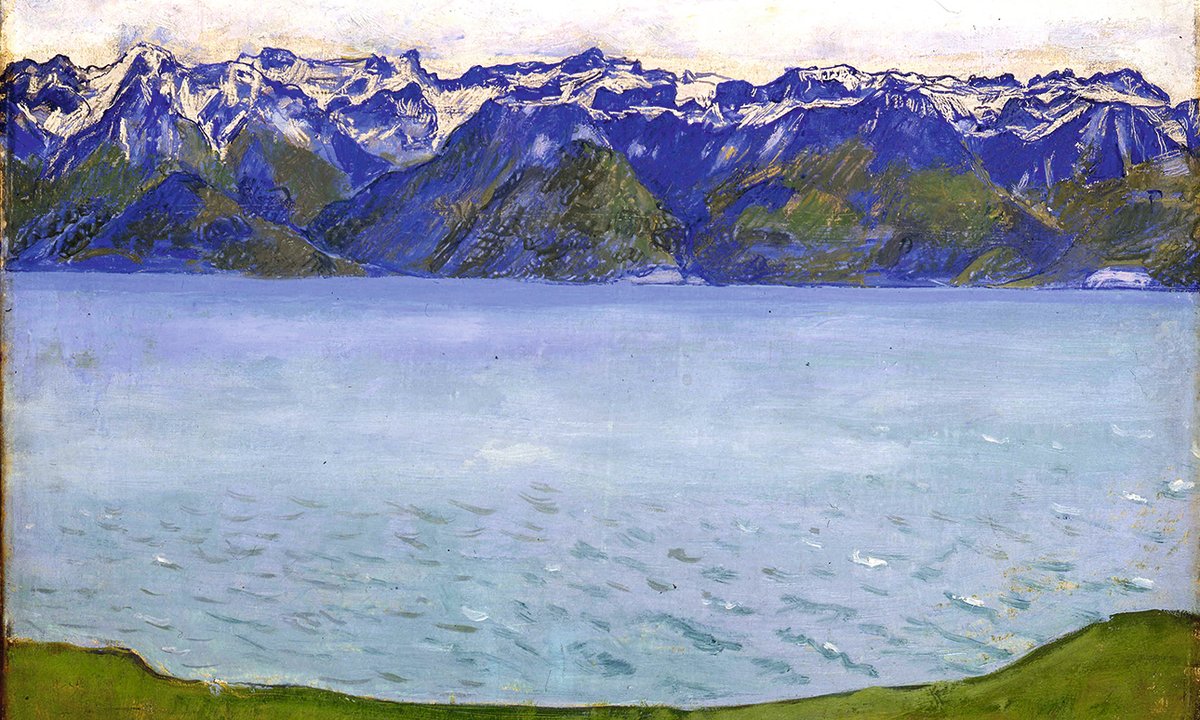
"Switzerland's master Symbolist Ferdinand Hodler (1853-1918) was born in Bern and influenced by the Old Masters he encountered in Basel, then settled in Geneva. By the early 20th century, his national standing-achieved through patriotic, stylised paintings and frescoes-meant that he had the means to devote himself to landscapes, which became his favoured genre. This small work (pictured above), with intimations of abstraction, compresses Geneva's nearby mountains into a barely jagged shelf, reflecting the artist's proclivity for horizontal compositions, even when depicting soaring Alpine peaks."
Graubünden has a longstanding influence on visual arts, nurturing key figures of European Modernism. The canton combines dramatic alpine landscapes, remote valleys, and a unique trilingual culture of Romansh, Italian, and German. Chur's Bündner Kunstmuseum holds major works related to Angelica Kauffman and the Giacometti family. Art, architecture, and design are distributed across valleys from Vals to Müstair, near Italy and Austria. Ferdinand Hodler achieved national stature with stylised, patriotic paintings and frescoes and later focused on landscapes with horizontal compositions and faint abstraction. Alberto Giacometti’s roots trace to Graubünden’s Italian-speaking Bergell Valley despite his Paris career.
Read at The Art Newspaper - International art news and events
Unable to calculate read time
Collection
[
|
...
]