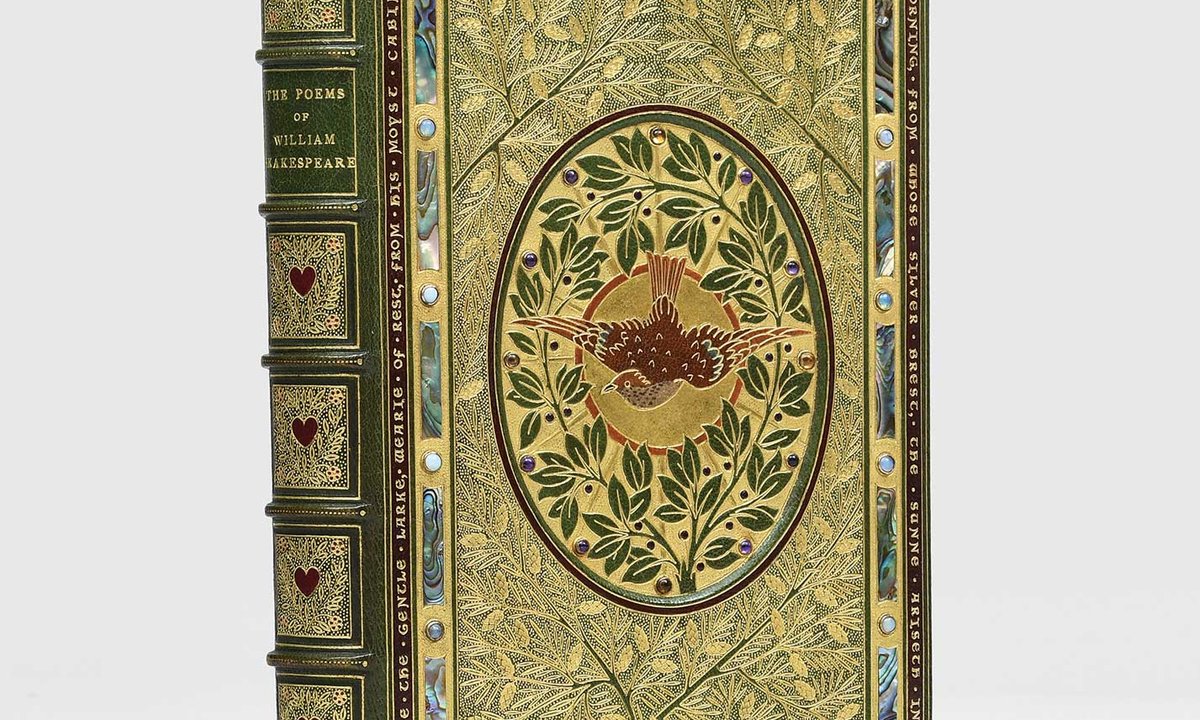
The Kelmscott Press, founded by William Morris in 1891, produced a first edition of Shakespeare's Poems bound by the renowned London bookbinders Sangorski and Sutcliffe. The binding features mother-of-pearl and over 100 precious stones, with decorative elements inspired by specific sonnets: violets, roses, and lilies from sonnet 99 on the inside back cover, and hearts with cupid's arrows referencing sonnet 116 on the inside front cover. This binding represents one of the most ornate surviving examples of the bindery's craft, particularly significant following the loss of their famous 'Great Omar' binding on the Titanic. Concurrently, contemporary Australian Indigenous art has experienced substantial market growth, driven by major exhibitions including The Stars We Do Not See at US venues and Tate Modern's survey of Emily Kam Kngwarray, an Anmatyerr artist who holds significant auction records.
"This first edition book of Shakespearean poems was published by Kelmscott Press, the private press founded by the English designer and author William Morris in 1891. This example is covered in an opulent, bejewelled binding from the renowned London bookbinders Sangorski and Sutcliffe. The decoration, set with mother-of-pearl and more than 100 precious stones, takes inspiration from the sonnets inside."
"Such bindings have been legendary since the loss of [Sangorski and Sutcliffe's] 'Great Omar' that sank with the Titanic, and this example stands as one of the most ornate and ambitious surviving expressions of the bindery's craft."
"Market interest in contemporary Australian Indigenous art has soared recently, helped by acclaimed shows such as the travelling US exhibition The Stars We Do Not See: Australian Indigenous Art, which just closed in Washington, DC, and Tate Modern's recently closed survey on one of the best-known Australian Indigenous artists, Emily Kam Kngwarray."
Read at The Art Newspaper - International art news and events
Unable to calculate read time
Collection
[
|
...
]