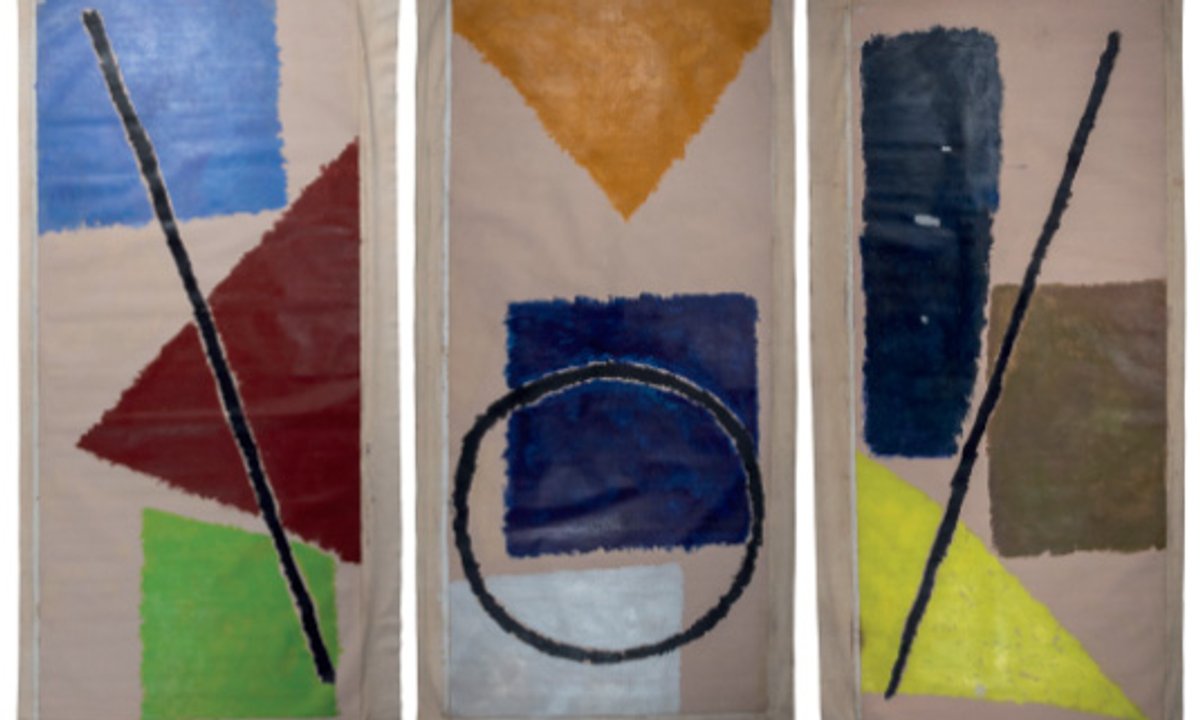
"Raman studied the relationship between light and colour, giving his name to the "Raman effect", which described the way light changes as it passes through different media. As such, it is especially fitting that, in Husain's 1987 series, which commemorated Raman's centenary, he brought his trademark angular forms of searing colour almost to the point of abstraction. These colours are arranged dynamically on the canvas, deployed economically but deftly to suggest rapid movement, and are intended to be a visual representation of Raman's theories."
"After Husain moved to Qatar in 2010, he began to indulge his interest in the legacy of Arab writers and philosophers throughout history-a subject that was close to his heart because of his Muslim faith and Arab ancestry. In his final large-scale commission, Husain was asked to create 99 works on different aspects of Arab civilisation; the number was chosen in a nod to the number of names and attributes used to describe Allah in classical Islamic thought. He completed 36 before his death and in one of them, Arab Astronomy, a large but tightly packed canvas,"
M.F. Husain's 1987 Raman Effect series visualizes C.V. Raman's discoveries about light and colour through angular, searing colours that verge on abstraction. The works deploy colour dynamically and economically to suggest rapid movement and to represent scientific concepts visually. Husain treated science and the arts as parallel pursuits of the same truth. After relocating to Qatar in 2010, Husain explored Arab writers and philosophers, influenced by Muslim faith and Arab ancestry. A final large-scale commission asked for 99 works on Arab civilisation; Husain completed 36 before his death, including the densely composed Arab Astronomy.
Read at The Art Newspaper - International art news and events
Unable to calculate read time
Collection
[
|
...
]