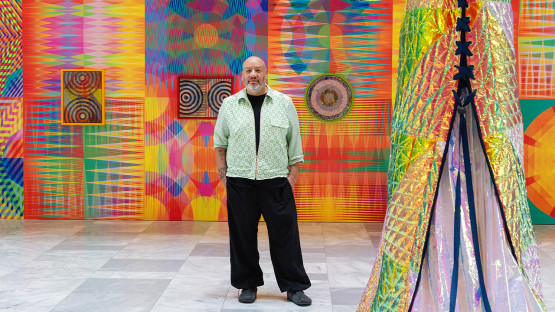
"For a lot of young artists, you don't really know where your career is going to take you or even if you're going to have a career. I feel like I was adding materials almost as a way of being literal about what I was trying to communicate about cultural lineage and practices. It was out of frustration that I started using rawhide and materials that were sold at powwows for regalia."
"The paintings were taking that idea and conceptually abstracting it, but when I started using those materials and showed that work to audiences, they immediately knew that it was not coming from European Western history. A lot of that work was done by the materials."
Jeffrey Gibson is an interdisciplinary artist known for immersive installations exploring themes of belonging through layered materials and cultural references. He made history as the first Indigenous artist to represent the U.S. with a solo exhibition at the 60th Venice Biennale. His work is held in permanent collections across the country. Gibson will speak at Cornell's College of Architecture, Art and Planning on March 24 as part of the John A. Cooper Visiting Artist Lecture Series. The series brings renowned artists to engage with students through lectures, studio visits, seminars, and critiques. Gibson's artistic evolution began with painting but expanded to include materials like rawhide and powwow regalia materials, allowing audiences to immediately recognize the work's cultural origins rather than European Western art history.
#indigenous-artist #interdisciplinary-art #cultural-identity #materials-and-installation #venice-biennale
Read at Cornell Chronicle
Unable to calculate read time
Collection
[
|
...
]