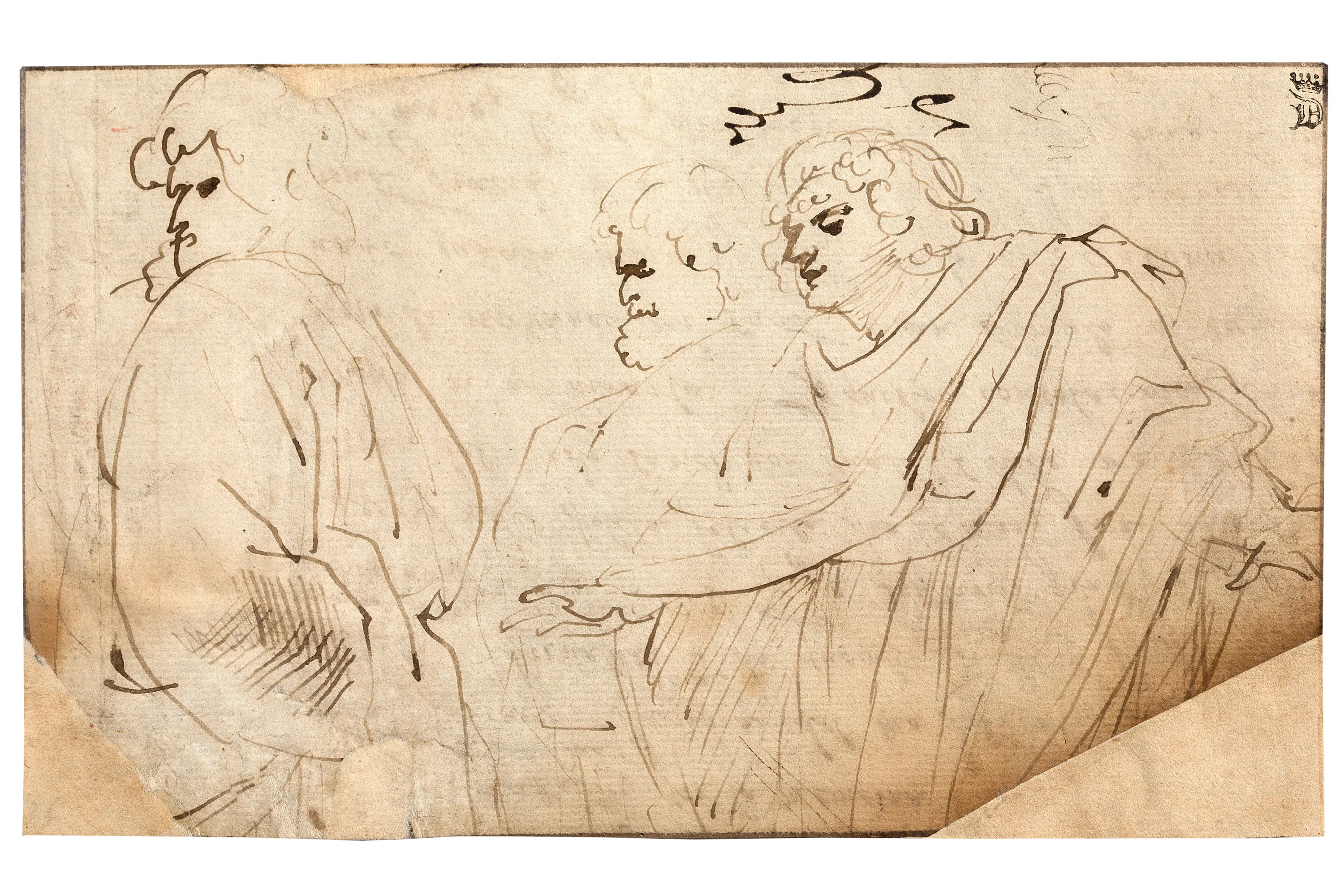
A double-sided sheet dated September 1607 contains wavy brown-ink quill marks, a swift sketch of three classical-robed men, and a draft letter on the reverse. The letter is addressed to Cristoforo Roncalli and asks about the progress of a painting made for shared patron Eleonora de' Medici. The sheet was acquired at TEFAF Maastricht by the King Baudouin Foundation for €110,000 and later displayed in Antwerp at the Rubens Experience. The drawing reflects Rubens’s second extended stay in Rome after moving there in 1606, when he sketched churches, public squares, and works from private collections accessed through his politically connected brother. The figures are thought to be apostles, and the letter calibrates tone toward Roncalli, a senior painter and Roncalli’s charge in Eleonora de' Medici’s service.
"“Is this quill working?” That is the question captured in the wavy brown-ink lines marking the top of a page pulled from Peter Paul Rubens's Roman notebook. Below the squiggles, likely made by the artist testing his quill pen, three men in classical robes are rendered in a swift, confident sketch. On the reverse, Rubens drafts a letter to the artist Cristoforo Roncalli, inquiring after the progress of a painting on behalf of their shared patron, Eleonora de' Medici."
"Dated to September of 1607, the double-sided sheet offers the young Fleming playing both artist and negotiator during his second extended stay in the Eternal City. More than 400 years on, the rare notebook sheet has gone on display in Rubens's hometown of Antwerp after being acquired at TEFAF Maastricht by the King Baudouin Foundation (KBF) for €110,000 ($121,100). The drawing and autograph letter made its first public appearance on May 19 at the Rubens Experience, where it will remain until the renovations on the Rubenshuis, Rubens's historic home, are completed in 2030 at the earliest."
"Rubens had moved to Rome in 1606 from Mantua and lived with his brother Philip, a lawyer in training, near the Spanish Steps. As his notebooks show, he sketched the Renaissance works of the city's churches and public squares-as well as those of private collections he gained access to through his politically well-connected brother. Although the three figures in the recently acquired drawing do not appear in any known Rubens works, they are thought to be apostles."
"The draft letter sees Rubens trying to calibrate his tone to address Roncalli, a painter who was both his senior and his charge in his role as Eleonora de' Medici's adviser. Rubens knew the Duchess from his years serving her husband, Vincenzo I Gonzaga, at the Mantuan court from 1600. Roncalli had been commissioned to paint a work for her private chapel, and she was growing impatient at the length of time it was taking."
Read at Artnet News
Unable to calculate read time
Collection
[
|
...
]