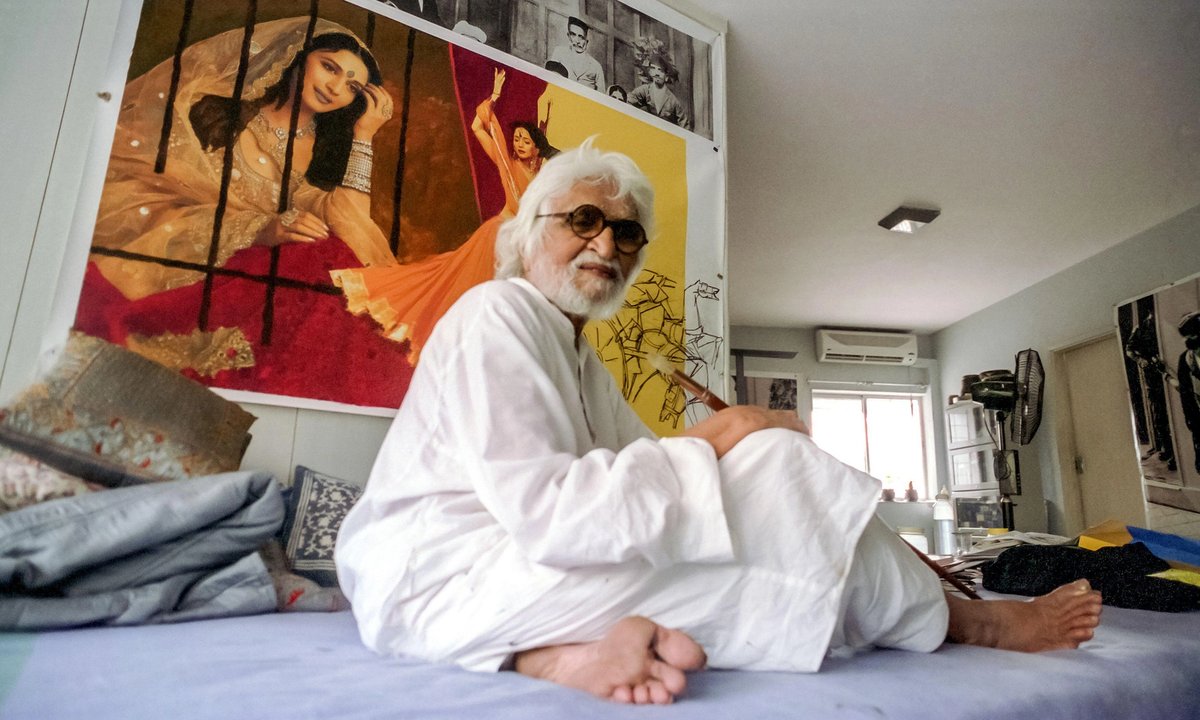
"But, by the time he died in London in 2011, he was no longer a citizen of India, but a Qatari, having moved to the Gulf state in 2009 and accepted citizenship the following year. What does it mean then that Husain, so often claimed as the "national artist" of India, spent his last years in Qatar? Lawh Wa Qalam: M.F. Husain Museum, seeks to answer that question."
"Husain was born in 1913, to a Shia Muslim family of distant Yemeni heritage in the small town of Pandharpur, around 200 miles southeast of Mumbai (then Bombay)-a glittering, cosmopolitan mercantile hub, home to India's canniest politicians and richest businessmen. He came of age in the febrile years leading up to the country's independence in 1947-and the violent Partition that, for a time, threatened to shatter the fluid, syncretic milieu in which Husain began to work as a young man."
M.F. Husain emerged from a Shia Muslim family of Yemeni heritage in Pandharpur in 1913 and trained amid Mumbai's cosmopolitan milieu. He matured during the independence movement and Partition, joining the Progressives to create a modern idiom blending Western technique with Eastern concepts. He produced work rooted in Indian heritage, drawing on folk art, religious iconography and cultural traditions. He painted large-scale works late in life, including Battle of Badr (2008) at age ninety-five. He left India for Qatar in 2009, accepted Qatari citizenship in 2010, and died in London in 2011. Lawh Wa Qalam museum addresses his relocation and legacy.
Read at The Art Newspaper - International art news and events
Unable to calculate read time
Collection
[
|
...
]