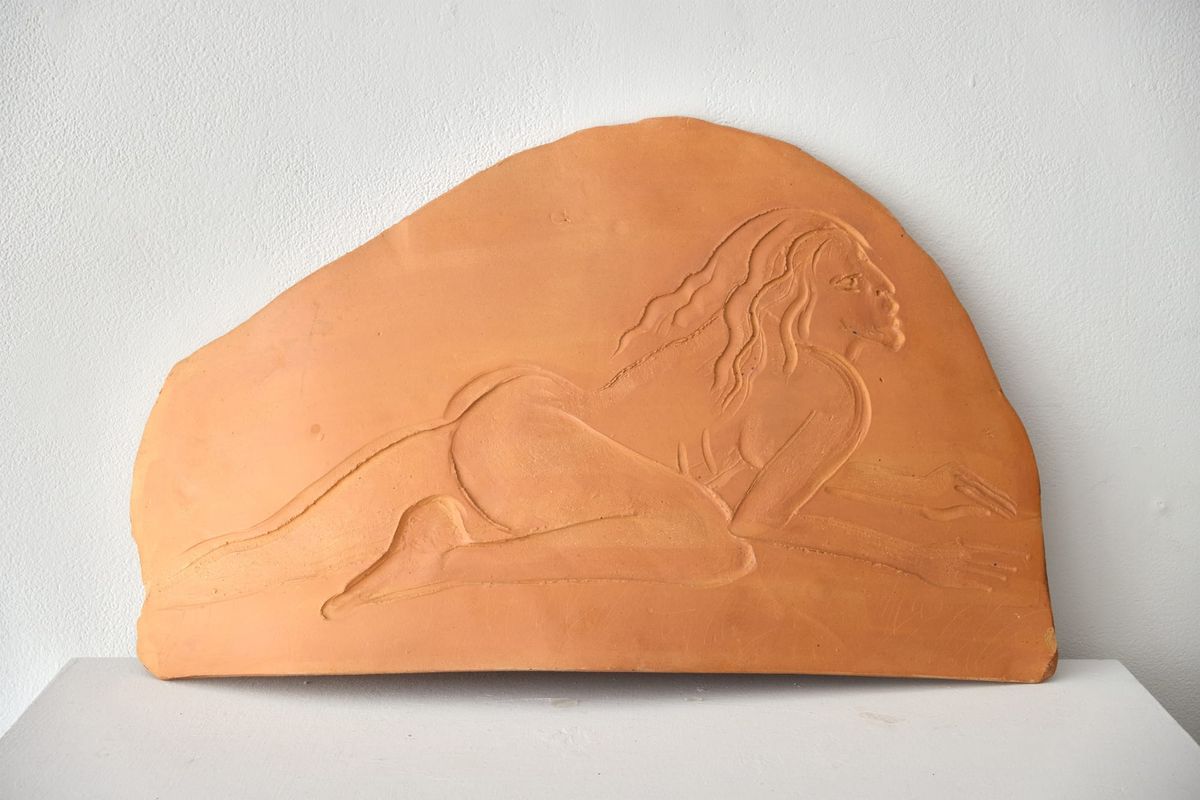
"Across sculptures and works on paper, her subjects are self-sustaining survivors who have not lost their capacity for tenderness."
"Curated by Harvey, the exhibition focuses on Frank's sculpture done between 1958 and 1985, including 11 sculptures made of wood, bronze, and ceramic, ranging from ones that fit in your palm to a large ceramic head seen in profile. Complementing this group are 5 works on paper, three of which are rendered in black ink. The two exceptions are a monotype, "Lovers" (c. 1980), and an oil-on-paper work, "Chasm" (1990), of a landscape in which a scumbled yellow sky illuminates the narrow passage between two different-colored mountains."
"At the outset of her career, Frank announced her interest in the mythic in "Winged Woman" (1958), a chiseled wood sculpture made from a single section of a telephone pole. She maintains an impossible pose, standing on one leg with the other leg raised and wrapped around her thigh. The mythic woman with agency has since become a recurring subject in Frank's work."
"She is not a goddess, at least not as they have been described in Greek and Roman mythology. These women are"
Sculptures and works on paper present mythic women as self-sustaining survivors who retain tenderness. Mary Frank’s practice follows a distinct path from male contemporaries who favored fabrication over handmade work. Her sculptures, created between 1958 and 1985, include wood, bronze, and ceramic pieces ranging from small works to a large ceramic head. The exhibition also includes works on paper, including black-ink drawings, a monotype titled “Lovers,” and an oil-on-paper landscape titled “Chasm.” Frank’s early “Winged Woman” establishes a recurring mythic figure with agency, not treated as a Greek or Roman goddess.
Read at Hyperallergic
Unable to calculate read time
Collection
[
|
...
]