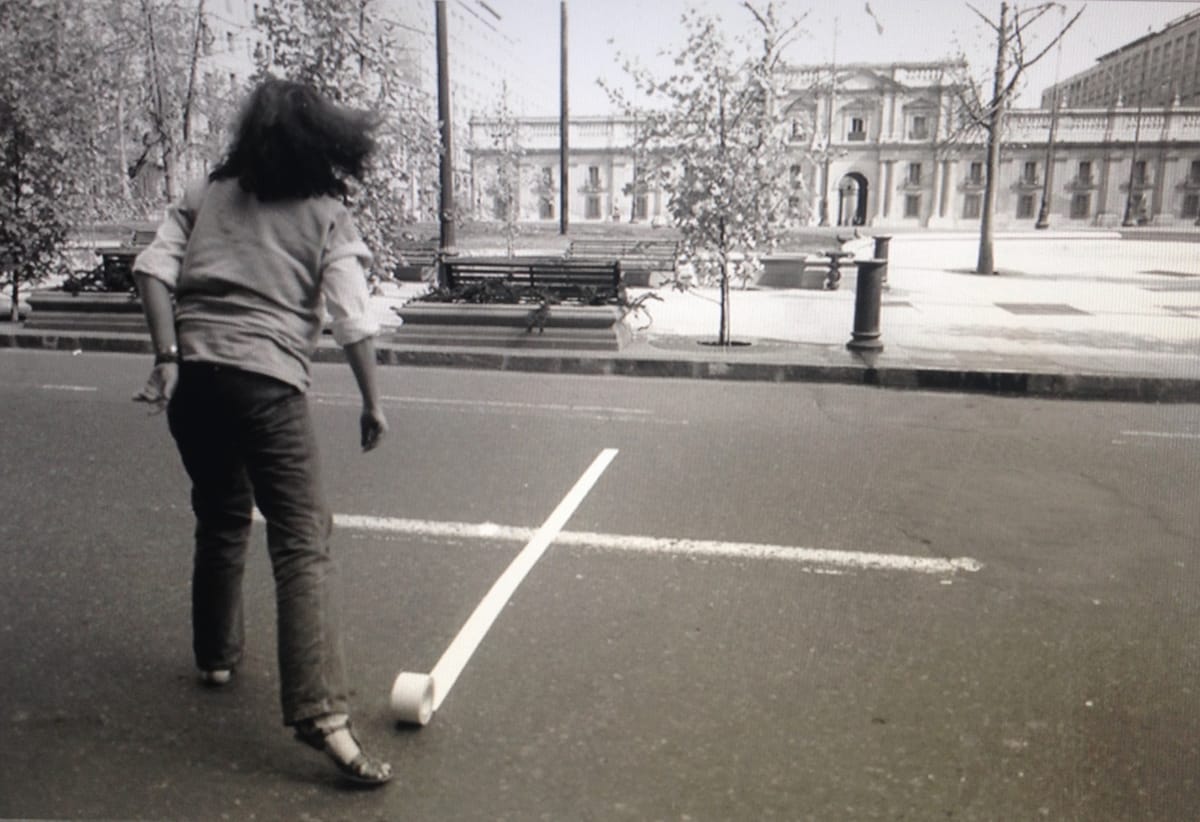
"Disobedient Spaces at Wallach Art Gallery approaches Lotty Rosenfeld's work through the slight deviations that, when repeated, begin to shift the political ground beneath an authoritarian regime. Born in Santiago, Chile, in 1943, Rosenfeld came of age under conditions that made such interference urgent. Her most iconic action, "Una milla de cruces sobre el pavimento" (One Mile of Crosses on the Pavement, 1979), was first carried out on Avenida Manquehue across the presidential palace in the early years of Augusto Pinochet's dictatorship."
"She attached white tape and bandages onto dashed traffic lines, transforming them into a trail of accumulated crosses. Grainy black-and-white footage follows Rosenfeld's slow processional march, her body bending forward to inscribe a disobedient line. The marks read sequentially as a tally - one that adds up the dead, the disappeared, the state's sanctioned silences. But it is also an improbable insistence that something additive and charged with possibility might still emerge from the negative."
Lotty Rosenfeld developed interventions that altered urban markings into political statements during Pinochet's dictatorship. She converted dashed traffic lines into crosses using white tape and bandages, creating a visual tally of the dead and the disappeared. Grainy black-and-white footage documents her slow processional, her body inscribing a disobedient line that repurposes pavement as a site of mourning and resistance. She repeated the action across Chile and internationally, moving from Avenida Manquehue to the Atacama Desert and outside the White House, allowing the mark to migrate across sociopolitical contexts while keeping its unruly charge.
Read at Hyperallergic
Unable to calculate read time
Collection
[
|
...
]