"Forty years ago, New York was almost the opposite of what it is today. Though the city had mostly pulled back from the brink of breakdown brought on by White Flight, bankruptcy, etc., by the early 1980s, whole neighborhoods still seemed to have collapsed. Little did I know at the time that, as bad as it was, the city had become a kind of canvas. Graffiti - the art movement of the day - filled the empty spaces. Walls, subway cars, you name it: Everything was covered with magic marker and spray cans."
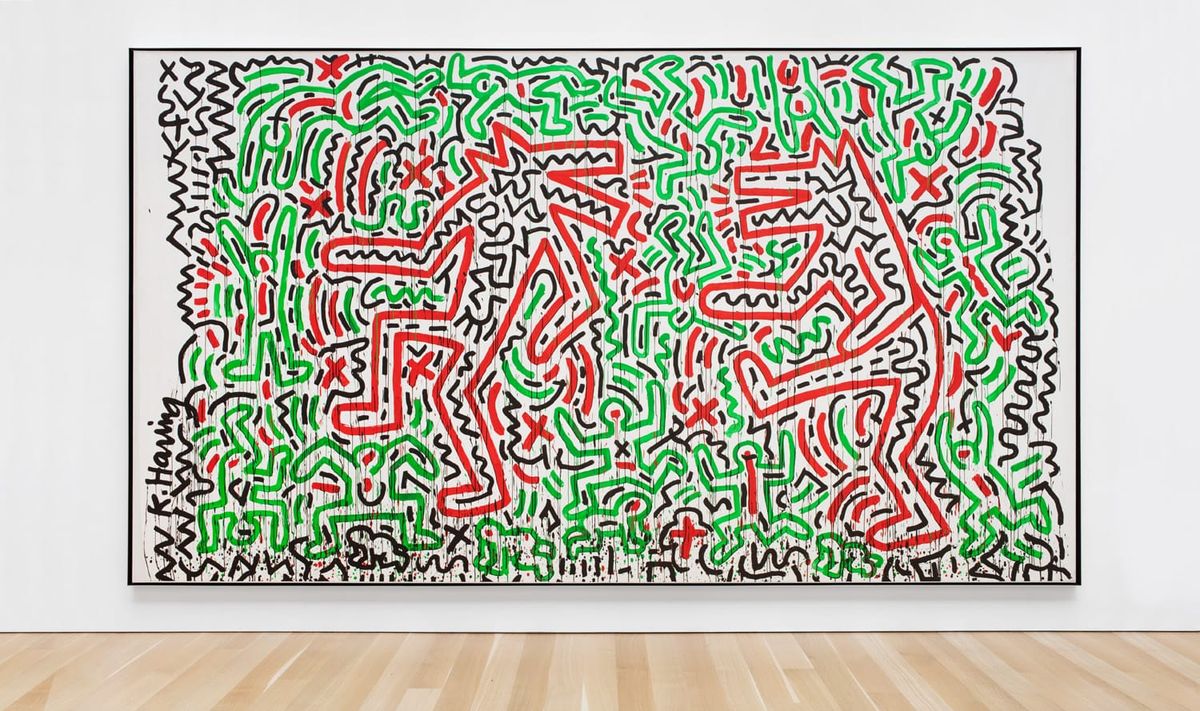
"This was when Keith Haring's work first appeared. And in this context, it seemed clever, upbeat, and lively. But to consider it art was different - it seemed to be trite, dashed off, sort of like the doodles that one might find in the margins of an art school notebook: radiant babies, Mickey Mice, and countless cookie-cutter figures. A recent visit to at the Brant Foundation, which focuses on his work from between 1980 and 1983, gave me an opportunity to recognize the dismissiveness of my youth. There really is more than meets the eye."
"Included in this exhibition are Haring's signature glyphic figures on reproductive ancient clay pottery, biblical images of golden calves being worshiped, and human sacrifices (perhaps condemned prisoners?) stretching up to a UFO laser-beaming everything from nuclear power plants and the Pyramids to big-brained dolphins. A pair of laughing dogs sitting back-to-back (dog-to-god?) is a vessel inhabited by multiple humanoids, each on their own mysterious mission. In a later piece, the same dogs are free of their human hosts."
New York in the early 1980s still showed neighborhood collapse, with graffiti filling walls and subway cars using magic marker and spray cans. Keith Haring’s early work appeared in this context as lively and clever, but it was initially dismissed as trite and hastily drawn. A later viewing of works from 1980 to 1983 at the Brant Foundation shows more complexity, including glyphic figures on ancient clay pottery, biblical scenes of golden calves, and human sacrifices reaching toward a UFO laser. Laughing dogs back-to-back appear as vessels inhabited by multiple humanoids on separate missions, and later versions remove the human hosts. The style feels prescient in relation to an impending AI upheaval.
Read at Hyperallergic
Unable to calculate read time
Collection
[
|
...
]