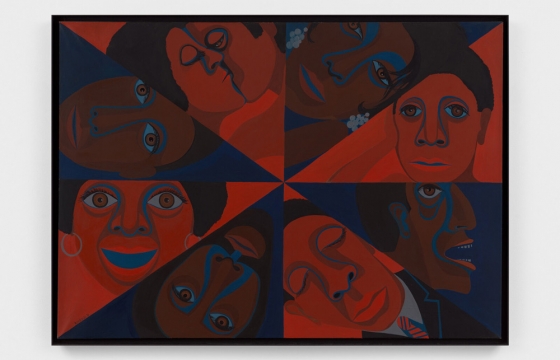
"Restlessly creative and formally ambitious, Ringgold explored the expressive potential of diverse media to create an incisive narrative about the historical sacrifices and achievements of Black Americans. Her practice emerged from the political consciousness and activism she developed during the 1960s and 1970s in Harlem, New York. Ringgold's early paintings and works on paper from this period combine her unique and graphic approach to figuration with a bold and innovative approach to constructing space, which she would continue to explore throughout her life."
"Inspired by the religious and spiritually significant Tibetan thangkas she first encountered when visiting the Rijksmuseum in Amsterdam, Ringgold's version manifested as paintings on unstretched canvas adorned with sewn fabric borders. It was the potential of these objects to explore the intersection of the craft and fashion traditions she inherited from her family with the history and techniques of European painting that inspired Ringgold and formally initiated her investigation into the medium that would become an integral part of her practice."
Faith Ringgold's career encompasses textiles (tankas, story quilts), early paintings, sculptures, and works on paper. She developed political consciousness and activism in 1960s-70s Harlem, combining graphic figuration with innovative spatial construction. She sought forms outside white art historical tradition to address gender and racial identity, traveling to Europe and Africa in the 1970s. Tankas—paintings on unstretched canvas with sewn fabric borders—merged family craft and fashion with European painting techniques, enabling portability and introducing textile practices that became central to her narrative about Black American sacrifices and achievements. Her work remains formally ambitious and restlessly creative across media.
Read at Juxtapoz
Unable to calculate read time
Collection
[
|
...
]