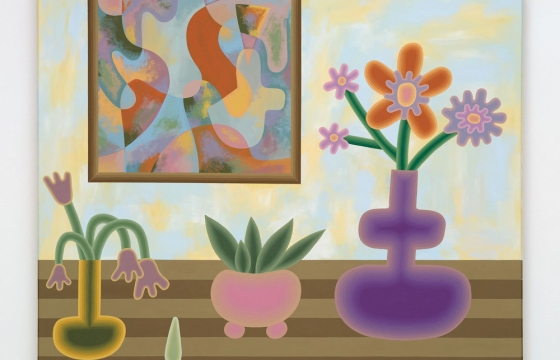
"Flowers, vases, stripes, grids, and looping forms recur across the exhibition, rendered in precise gradients and graphic color combinations. The works feel simultaneously playful and controlled: blooms swell to near-cartoon proportions, stems curl into coiling lines, and patterned backgrounds - gingham, stripes, checkerboards - flatten space while heightening visual rhythm. While flowers have long functioned as symbols of beauty and femininity, Pendergrast treats them as formal tools, vehicles for testing color, composition, and structure."
"Many of Pendergrast's compositions originate in quick, intuitive drawings, which are later translated into paintings through a slow, methodical process of layering and refinement. Her systematic approach to color, often built around controlled gradients and harmonies, is periodically disrupted. Static points interrupt compositional flow; edges misalign; color systems break open. In several works, leftover paint from previous canvases is reused, introducing chance into an otherwise exacting process."
Abstracted still lifes feature flowers, vases, stripes, grids, and looping forms rendered in precise gradients and graphic color combinations. Blooms swell to near-cartoon proportions, stems curl into coiling lines, and patterned backgrounds—gingham, stripes, checkerboards—flatten space while heightening visual rhythm. Flowers function as formal tools for testing color, composition, and structure rather than symbols of beauty or femininity. Compositions begin as quick, intuitive drawings and are realized through slow, methodical layering and refinement. Controlled color harmonies are periodically disrupted by misaligned edges, static interruptions, and reused paint, introducing chance and vulnerability beneath a polished surface. References range from hard-edge modernism to miniature painting.
Read at Juxtapoz
Unable to calculate read time
Collection
[
|
...
]