"Ali Eyal is an Iraqi artist working across painting, drawing, assemblage, and film to examine how personal memory tangles with political violence and loss. Born in Baghdad in 1994, Eyal orients much of his practice around vanished places: the unelectrified dark of a childhood bedroom in the city; an uncle's farm south of Baghdad; and other familial spaces now destroyed and existing only in the artist's imagination to which he returns again and again through the circuitous routes of memory and reinterpretation."
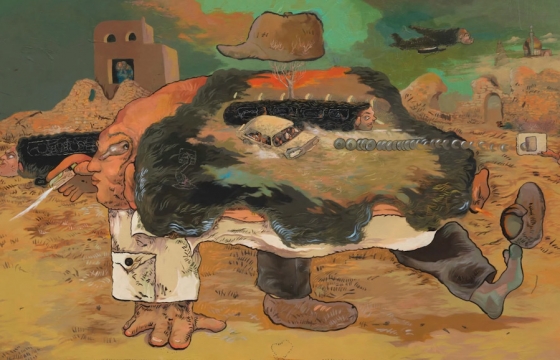
"His images unfold in a cartoonish, sometimes grotesque idiom that sidesteps realism. Instead, Eyal finds in exaggeration and distortion a sharper instrument for rendering what he calls "the after war." This refers to the lingering psychological wake of conflict, and the way state violence continues to reverberate through survivors and diasporic communities long after wars end. Eyal's canvases teem with color and incident, their dense, heady compositions animated by an internal logic that refuses easy legibility."
"In Imagine, this happened just an hour ago, Eyal presents a group of oil paintings and framed drawings that interpolate childhood memories, recurring characters, familial mythology, and insinuations of exile, surveillance, and disappearance. The exhibition's title suggests the temporal collapse that is characteristic of traumatic memory, where past events persist with startling immediacy in the present. Throughout the works, individual figures' thoughts are often depicted through vignettes or literal doorways carved into their heads, or else bleeding into the present moment with hallucinatory clarity."
Ali Eyal presents oil paintings and framed drawings that interpolate childhood memories, recurring characters, familial mythology, and insinuations of exile, surveillance, and disappearance. His imagery unfolds in a cartoonish, sometimes grotesque idiom that sidesteps realism and uses exaggeration and distortion to render the lingering psychological wake of conflict he terms "the after war." Vanished places such as an unelectrified childhood bedroom and an uncle's farm become recurring sites of imaginative return, reconstructed through memory's circuitous routes. Figures' thoughts appear as vignettes or as literal doorways carved into heads, bleeding past events into the present with hallucinatory immediacy. Dense compositions refuse easy legibility while insisting on suppressed stories.
#traumatic-memory #iraqi-contemporary-art #grotesque-figurative-painting #state-violence-and-diaspora
Read at Juxtapoz
Unable to calculate read time
Collection
[
|
...
]