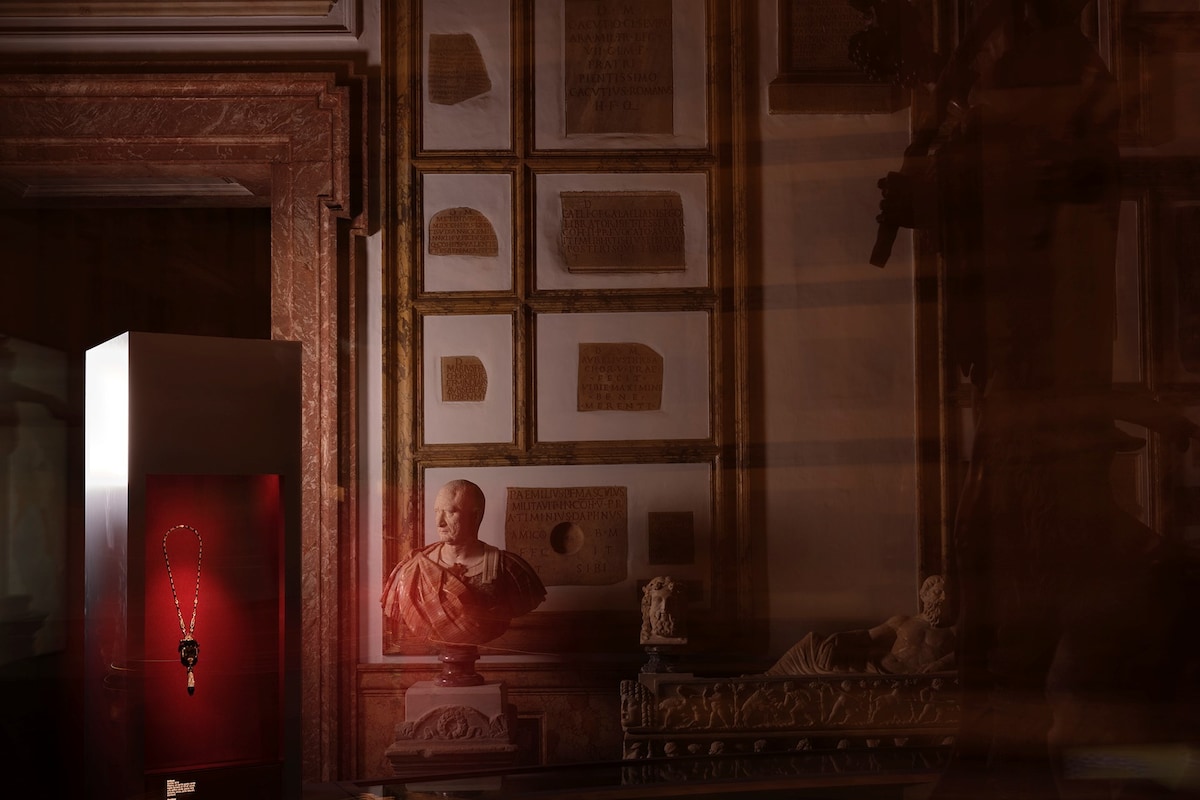
"Okay, so citing a correlation between pretty much any creative expression from the Renaissance onwards and Greco-Roman classicism is hardly rocket science. The word itself, meaning "rebirth", is tied to a rediscovery of classical art and ideals of Ancient Greece and Rome, often through direct emulation and assimilation - English architectural follies that resemble Roman temples, 18th-century evening muslin gowns that look like Greek draped states."
"Since 1989, Cartier has staged some 45 exhibitions exploring its enviable and truly priceless archive, in locations flung far - Shanghai, Mexico City and at the Louvre in Abu Dhabi, over only the past two years. Yet there has only been one exhibition to date in Italy, curated by design aficionado Ettore Sottsass back in 2002 and shown in Milan. Roads have never led to Rome, strangely, until now."
Greco-Roman classicism influenced creative expression from the Renaissance onward, inspiring architectural follies, gown styles and jewelry motifs such as micro mosaics, columns and Greek key patterns. Cartier & Myths opened at the Musei Capitolini in Rome to explore those classical connections through jewelry. Cartier has staged around 45 exhibitions since 1989 in global venues including Shanghai, Mexico City and the Louvre in Abu Dhabi, with only one prior Italian show in Milan in 2002. The Rome presentation marks multiple firsts: Cartier's first show in the Eternal City, the first placement of its creations alongside museum items, and the Capitolini's first temporary exhibition. The display occupies the Palazzo Nuovo, a 1654 space filled with 18th-century statuary from Cardinal Alessandro Albani's collection. Curators Bianca Cappello, Stéphane Verger and Claudio Parisi Presicce swirl together Cartier pieces, ancient artifacts and loans of jewels.
Read at AnOther
Unable to calculate read time
Collection
[
|
...
]