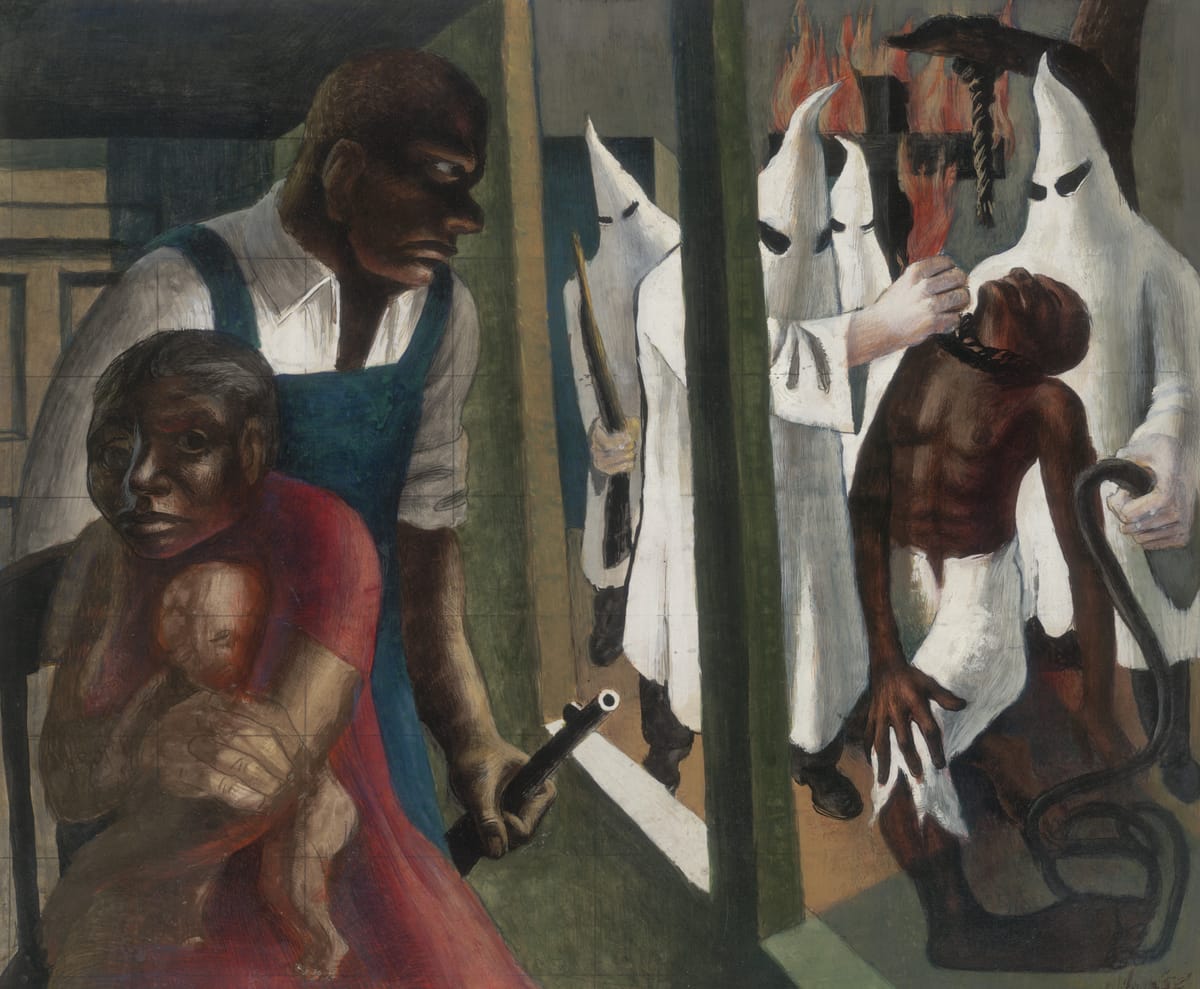
John Wilson, born in 1922 to Guyanese immigrants in Roxbury, Massachusetts, drew direct inspiration from Richard Wright’s protest fiction. Wilson produced politically charged paintings and lithographs titled after or inspired by Wright’s books, including works referencing Black Boy and Native Son. The exhibition Witnessing Humanity presents Wilson as a passionate reader who used art to confront racial violence and its effects on Black families. Wilson’s imagery emphasizes rural and working-class men striving to maintain dignity amid oppression. The work aligns with Marx’s insight that social being shapes consciousness, as subjects embody systemic pressures on identity and agency.
"One of the most influential writers of the 20th century, he inspired many, including a young John Wilson, born in 1922 to Guyanese immigrants in the working-class neighborhood of Roxbury, Massachusetts. Wright, who established himself in the literary world in the decade before Wilson emerged in art, profoundly impacted the modern artist - his words appear in the political prints and paintings Wilson would go on to make."
"Witnessing Humanity reveals Wilson as a passionate reader, creatively invigorated by Wright's protest fiction and inspired to charge his art with political purpose. Walk through the retrospective, and you'll see Wilson, like Wright before him, wrestling with the psychic toll of racial violence on Black families in his paintings and lithographs. In A Contribution to the Critique of Political Economy (1859), Karl Marx wrote: "It is not the consciousness of men that determines their being, but on the contrary, their social being that determines their consciousness.""
Read at Hyperallergic
Unable to calculate read time
Collection
[
|
...
]