"The first globe-a spherical representation of our planet Earth-dates back to the Age of Discovery. Or 1492, to be more precise, when Martin Behaim and painter Georg Glockkendon created the "Nürnberg Terrestrial Globe," otherwise known as the "Erdapfel." It was made by hand. And that tradition continued straight through the 20th century, until machines eventually took over."
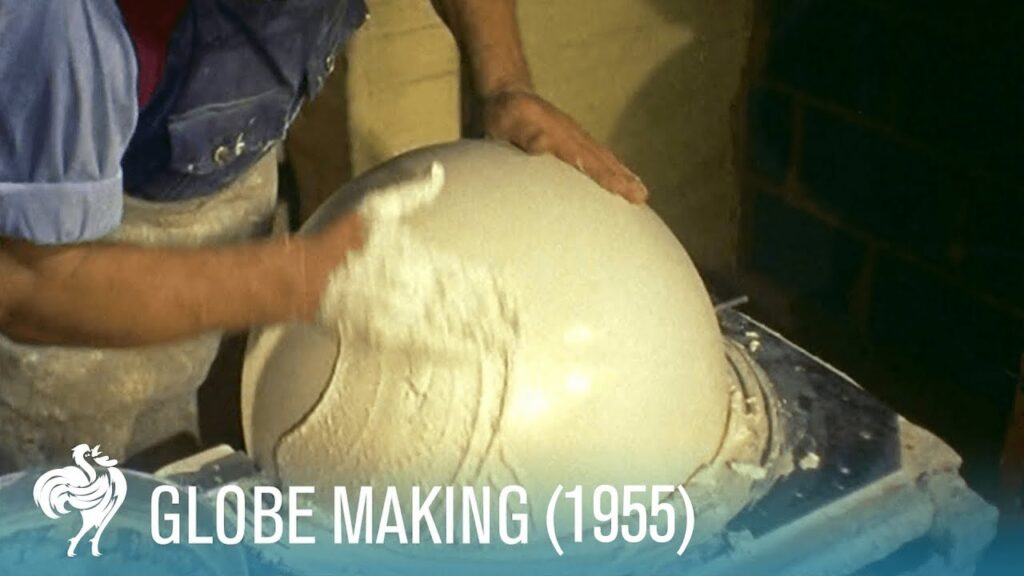
"Somewhere in North London, in 1955, "a woman takes one of the moulds from a shelf and takes it over to a workbench. She fixes it to a device which holds it steady whilst still allowing it to spin." "Another girl," notes British Pathe, "is sticking red strips onto a larger sphere." After that, "coloured printed sections showing the map of the world are cut to shape then pasted onto the surface of the globes.""
"Through that "skilled operation," the London-based firm produced some 60,000 globes each year. Here, you can also watch another globe-making mini-documentary, this one in black & white, from 1949. It gives you a glimpse of a process that takes 15 hours, from start to finish."
The spherical representation of Earth known as the globe originated in 1492 with the creation of the Nürnberg Terrestrial Globe by Martin Behaim and painter Georg Glockkendon. This handmade tradition persisted for five centuries until mechanization eventually took over. In 1955 North London, a documented manufacturing process showed skilled workers assembling globes by hand, producing approximately 60,000 units annually. The complete globe-making process required 15 hours from start to finish, involving mold preparation, sphere assembly, and the careful application of colored printed map sections to the globe surface.
Read at Open Culture
Unable to calculate read time
Collection
[
|
...
]