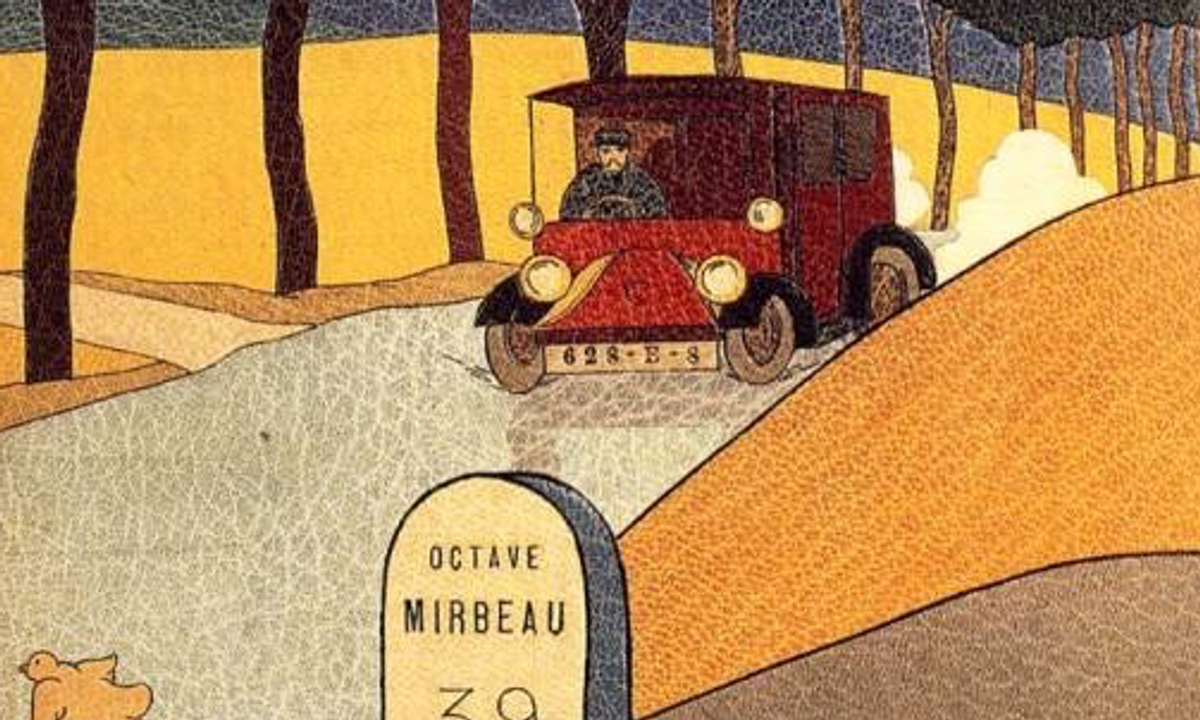
"In 1907 Octave Mirbeau, a Parisian avant-garde writer, published a fictional travelogue about a drive through northern Europe, which included a Van Gogh pilgrimage. This was well before the artist had achieved fame. Mirbeau entitled the book La 628-E8, after the licence plate of his own car. Automobiles were then still a rarity on French roads, with only around 25,000 vehicles in the entire country."
"The writer, a passionate art lover, was devoted to Van Gogh's work, having been the first person to buy his paintings after the artist's death. In 1891 he had paid 600 francs (then £24) for Three Sunflowers (August 1888) and (May 1889). Soon afterwards Mirbeau was visited by his friend Claude Monet, who on seeing the two floral paintings commented: "How could a man who has loved flowers and light so much and has rendered them so well, how could he have managed to be so unhappy?""
Octave Mirbeau published La 628-E8 in 1907, a fictional travelogue describing an automobile drive through northern Europe that includes a pilgrimage to Van Gogh sites. The book’s title comes from the licence plate of Mirbeau’s own car, a Charron model, at a time when automobiles were rare in France. Mirbeau had been an early purchaser of Van Gogh’s work, buying paintings in 1891. The traveller in the book seeks Van Gogh’s birthplace and attempts to find people who knew the artist, while Monet’s reaction to Sunflowers and Irises highlights the contrast between Van Gogh’s luminous art and his unhappiness.
Read at The Art Newspaper - International art news and events
Unable to calculate read time
Collection
[
|
...
]