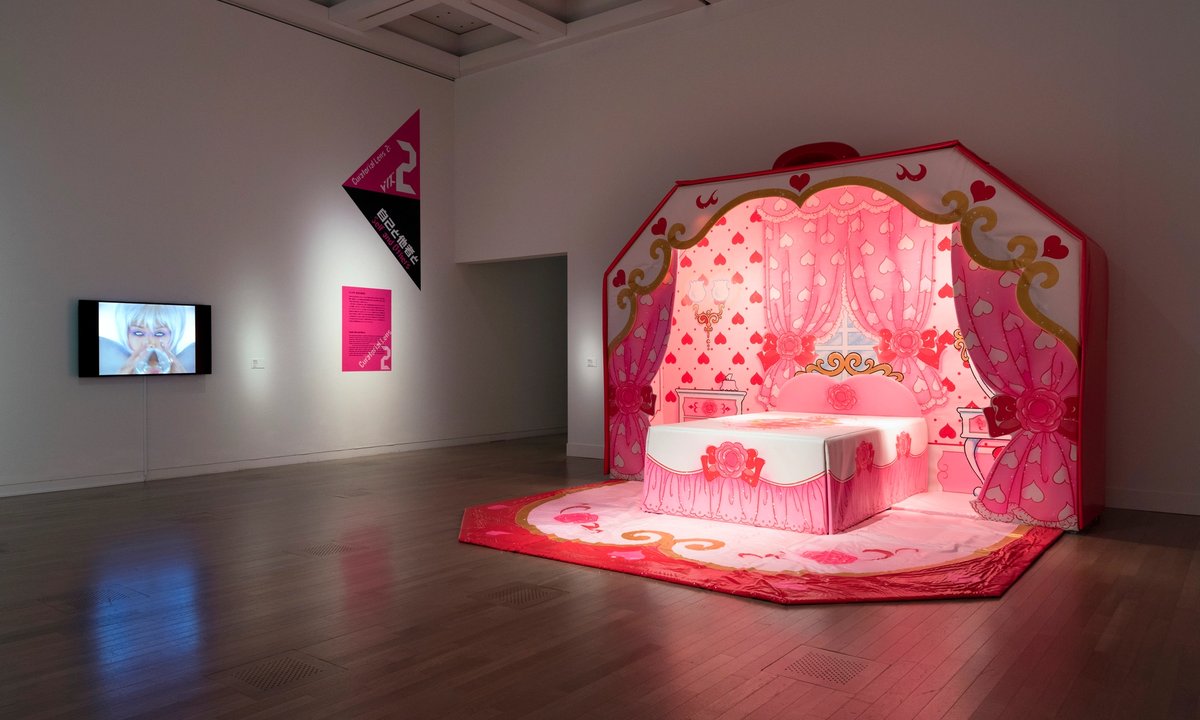
"Eriko just felt that it was time to have an inter-regional relationship with a major institution in East Asia, and so to work together. Both of us felt it was very important to start having significant collaborations with like-minded institutions," says Raffel, who is now the museum director of M+ museum in Hong Kong, which collaborated with the National Art Center Tokyo (NACT), on the project at the Japanese institution, now helmed by Osaka."
"A partnership based on collaborative research, bringing in new information on both sides, the push and pull of here and there can make an exhibition something that you wouldn't be able to without the other," Raffel says. "Without the other we could not make something as rich as what you see in Prism of the Real."
"The exhibition is framed around two Japanese imperial time periods, the Shōwa era (1926-89) and the Heisei era (1989-2019), to present moments of economic turmoil when the country's art first leaned into global contemporary art then embraced and powerfully reshaped it."
Prism of the Real traces Japanese contemporary art from 1989 to 2010 through regional and global interactions. The exhibition grew from a professional relationship that began in 1999 between Osaka Eriko and Suhanya Raffel after their collaboration at the third Asia-Pacific Triennial in Brisbane. M+ in Hong Kong and the National Art Center Tokyo formalized a partnership, signing an MOU in 2024, and curated the show together. Curators include Doryun Chong, Isabella Tam, Kamiya Yukie and Jihye Yun. The exhibition uses Shōwa and Heisei eras to highlight moments of economic turmoil when Japanese art engaged with and reshaped global contemporary art.
Read at The Art Newspaper - International art news and events
Unable to calculate read time
Collection
[
|
...
]