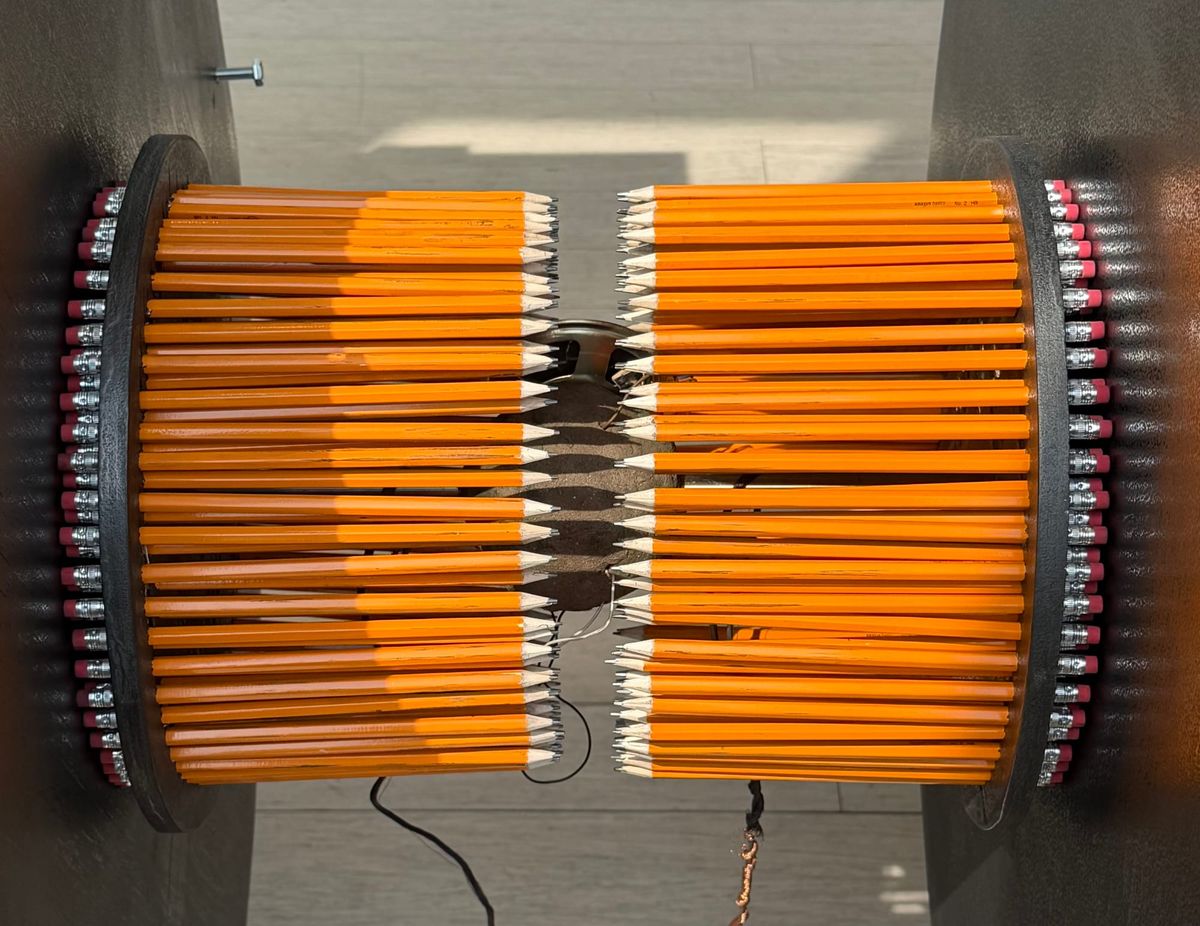
Alejandro Valencia’s multipart installation in Columbia University’s MFA show directly names the institution’s failure to come to terms with Israel’s genocide of Palestinians. The work, “DYNAMO (RATM01)” (2026), resembles an engine room and alludes to hidden institutional machinery. Three modules include sundials that reference the university’s central campus landmark while compressing and constricting what they hold. The 2026 MFA cohort began in fall 2024 after forced clearings of student encampments protesting the genocide in Gaza. The period included crackdowns, protests, arrests, and human rights violations involving ICE. Students also faced repeated removal of posters calling for Free Palestine and the Intifada. The installation’s first section includes a keffiyeh that belonged to Ridwana Rahman, worn during campus protests.
"In Columbia University's MFA show, artist Alejandro Valencia loudly names the elephant in the room: The Manhattan school's institutional failure to come to terms with Israel's genocide of Palestinians. "DYNAMO (RATM01)" (2026) is included in the Visual Arts + Sound Art Class of 2026's thesis exhibition, on view at the Miriam and Ira D. Wallach Art Gallery through this Sunday, May 24. The work resembles an engine room, alluding to the institution's hidden machinery. Its three modules feature sundials, evoking the university campus' iconic central landmark, but compressing and constricting what they precariously hold."
"Columbia's 2026 graduating MFA cohort had to weather a storm on the way to their degree. The class matriculated in the fall of 2024, following the April 30, 2024, forced clearings of the university's student encampments protesting the genocide in Gaza. The aftermath was intense - more crackdowns, protests, arrests, and human rights violations from ICE that kept the campus environment hostile."
"The cohort got off to a divisive start. According to Ridwana Rahman, another MFA student, she had printed out several posters that read "Free Palestine, Long Live the Intifada" during the 2025 spring semester. She and several of her classmates then chose to hang them on their studio doors. A few days later, an undergraduate student ripped them down. Another MFA student then replaced their poster, only to have it ripped down again."
"The first section of Valencia's piece on view features a keffiyeh that belonged to Rahman, who wore the headscarf during protests against the Gaza genocide on campus"
Read at Hyperallergic
Unable to calculate read time
Collection
[
|
...
]