"PARIS - Echo Delay Reverb: American Art, Francophone Thought at Palais de Tokyo is billed as an exploration of the influence of French critical theory - including and perhaps especially thinkers in Francophone Africa and the Caribbean such as Frantz Fanon and Aimé Césaire - on American art. For those who have encountered critical theory and indulge in the occasional Marx meme, the show may sound like catnip, but such conceits often slip into theory- and text-heavy curation that is opaque to many viewers. So it was refreshing to find the exhibition's theoretical points concisely made, historically situated, and woven through excellent wall labels that contextualize a wealth of strong artworks."
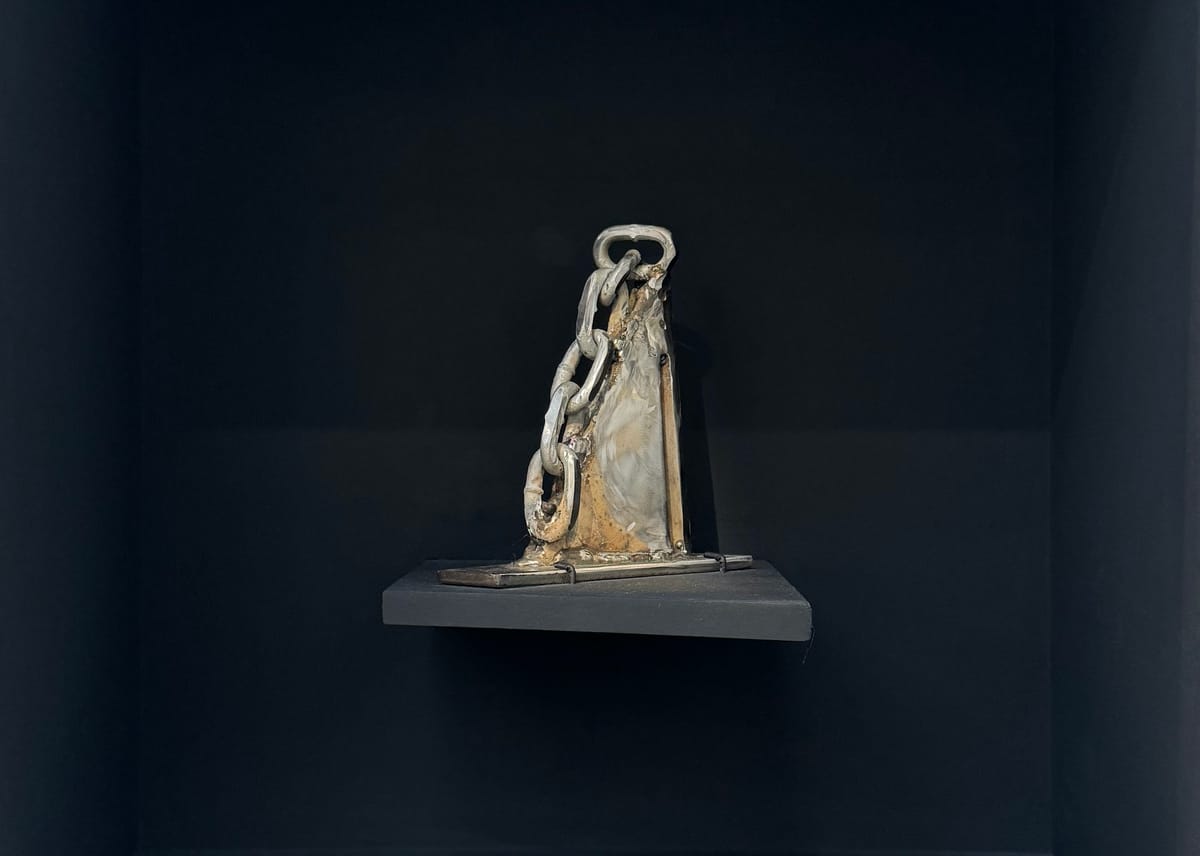
"The pieces on view range from his small Lynch Fragments series to larger installations composed of barbed wire or sizable industrial objects - some freighted with meaning, such as a short length of chain or shackle, others more ambiguous, like a finial or a single metal cube - that play up the works' formal qualities: the heavy made to look impossibly light, the razor sharp to appear delicate. Edwards's sculptures lay bare the ways in which the material realities of labor, incarceration, and death still evoke violent associations even when the machines that enable those processes are broken out into component parts."
Echo Delay Reverb: American Art, Francophone Thought at Palais de Tokyo traces the impact of French critical theory, particularly Francophone African and Caribbean thinkers like Frantz Fanon and Aimé Césaire, on American art. The exhibition uses concise theoretical framing and clear wall labels to situate artworks historically and conceptually. Melvin Edwards occupies the entrance with Lynch Fragments and larger installations of industrial materials that evoke labor, incarceration, and death. The works emphasize formal tensions—heavy made to seem light, razor sharp appearing delicate—and reveal ongoing violent associations when instruments of power are decontextualized.
Read at Hyperallergic
Unable to calculate read time
Collection
[
|
...
]