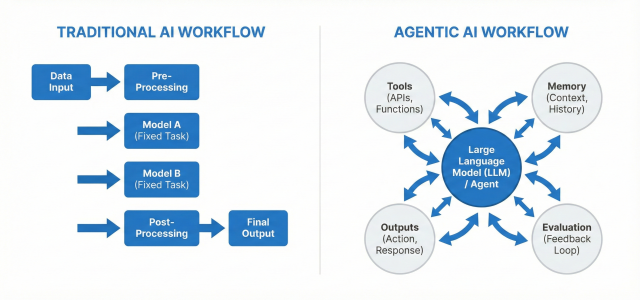
"Agentic AI workflows sit at the intersection of automation and decision-making. Unlike a standard workflow, where data flows through pre-defined steps, an agentic workflow gives a language model discretion. The model can decide when to act, when to pause, and when to invoke tools like web search, databases, or internal APIs. That flexibility is powerful - but also costly, fragile, and easy to misuse."
"Agentic AI workflows introduce a new ingredient: choice. An agent can decide whether to call a tool, which tool to call, or whether it already "knows enough" to proceed. As Sinan Özdemir has noted in discussions around agent design, the defining moment is when the model has the power not just to use tools - but to decide whether to use them at all."
Agentic AI workflows empower language models with discretion to act, pause, or invoke external tools like web search, databases, and internal APIs. Deterministic workflows follow fixed execution paths and perform well for well-defined tasks where latency and cost predictability matter. The addition of choice enables agents to decide whether and which tools to call, creating hybrid workflows that mix autonomy and predefined steps. That choice improves adaptability and capability but also increases operational cost, fragility, and misuse risk. Successful production systems often use hybrid agentic approaches rather than fully autonomous agents, requiring careful judgment about when autonomy adds value.
Read at Medium
Unable to calculate read time
Collection
[
|
...
]