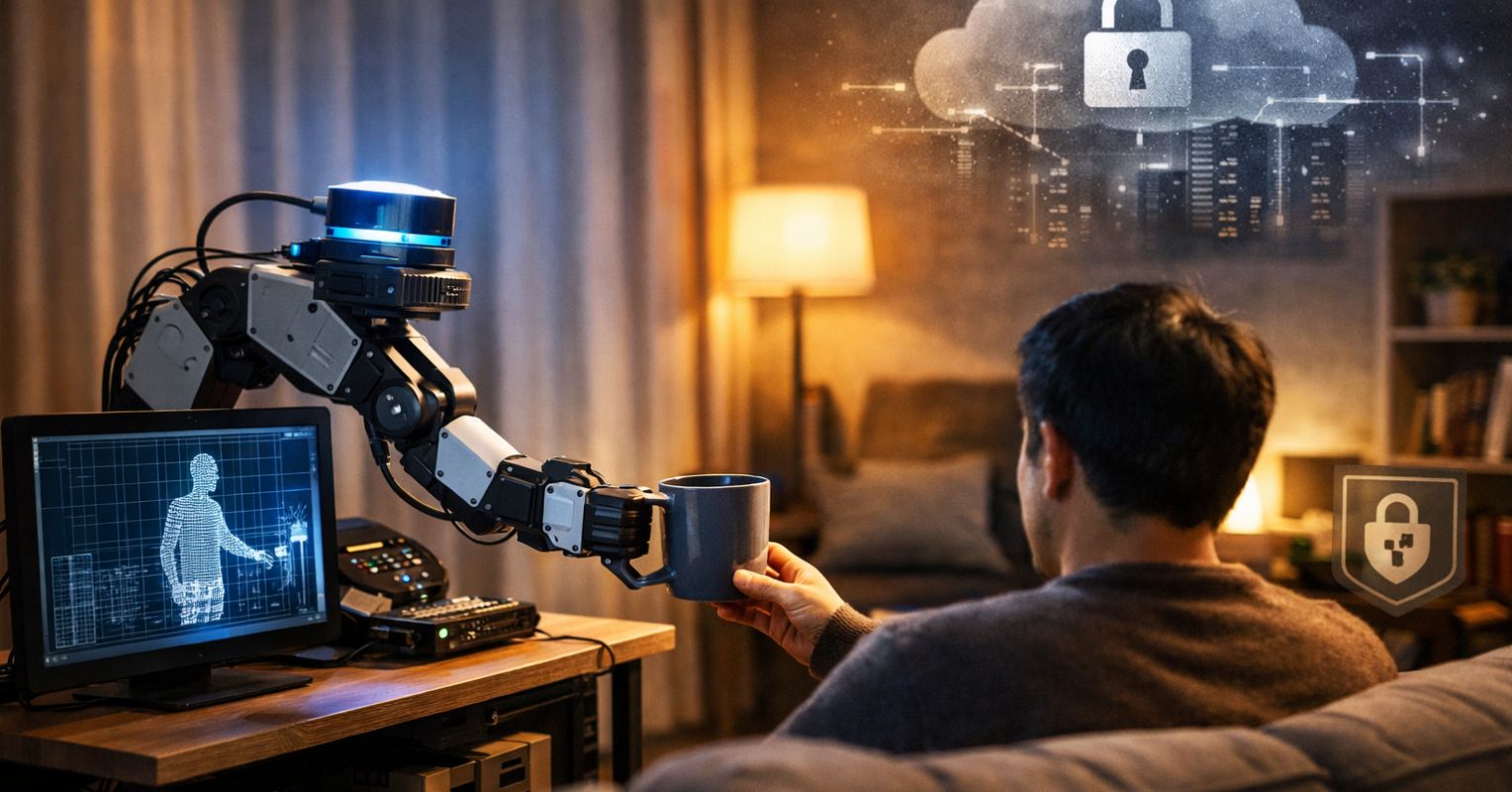
"Recently, an open-source project called OpenClaw surfaced on a maker community platform. Built on affordable edge-computing hardware, the project demonstrated a local AI agent controlling a physical robotic arm. It wasn't just predicting text; it was moving motors, reading sensors, and interacting with its physical environment in real-time. From a psychological and sociological perspective, this transition from abstract AI to embodied local AI forces us to re-evaluate trust, privacy, and the sanctity of our personal space."
"When you live alone, your home is your ultimate sanctuary. It is the one place where you are entirely unobserved. As robots inevitably join our daily lives to assist with physical tasks, domestic management, or even just to provide an interactive presence, the psychological friction peaks. Introducing a camera-equipped machine into a single-person household can quickly feel less like assistance and more like an invasion."
"This is where the engineering choices behind grassroots projects like OpenClaw offer a fascinating psychological solution to the privacy problem. To allow the robot to see and navigate, developers are moving away from traditional RGB cameras (which capture high-resolution images of our faces, habits, and private moments) and instead repurposing tools like depth sensors and LiDAR."
Artificial intelligence is transitioning from disembodied cloud-based systems to embodied local AI controlled by affordable hardware in maker spaces and garages. Projects like OpenClaw demonstrate robots with real-time physical interaction capabilities. This shift fundamentally changes psychological boundaries between humans and machines, particularly for the growing demographic of adults living alone. Home environments represent ultimate personal sanctuaries where privacy is paramount. Introducing camera-equipped machines into single-person households creates psychological friction, transforming assistance into perceived invasion. Open-source developers address privacy concerns by replacing traditional RGB cameras with depth sensors and LiDAR technology, enabling robots to navigate and interact while preserving visual privacy and personal space.
#embodied-ai #privacy-and-robotics #local-ai-systems #single-person-households #open-source-hardware
Read at Psychology Today
Unable to calculate read time
Collection
[
|
...
]