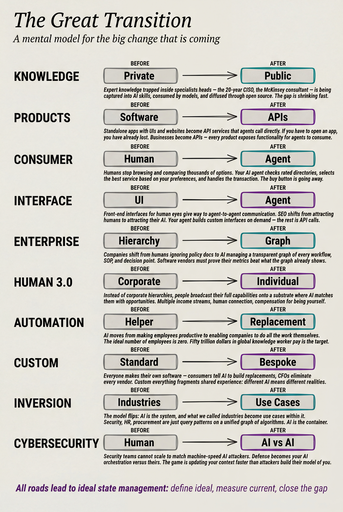
"In the past, going back 10, 20, 30, 50 years, if you were an expert in something, you had knowledge that no one else had. If you were a specialist consultant at McKinsey or you were a heart doctor or whatever, you had special knowledge. And you hadn't captured even a 10th of it. Let's say you've written two books-you still haven't captured a 10th of your knowledge."
"LLMs in general, AI in general. The concept is that it consumes all the stuff from the internet-all the books, all the blogs, forum conversations-all this training that's been done on these models. All of that condenses into a model that's kind of representative of all this knowledge. What's not so much understood is what this is actually doing to knowledge work."
A major transition is occurring across multiple domains simultaneously, driven primarily by large language models and AI technology. Historically, experts possessed specialized knowledge unavailable to others—consultants, doctors, security professionals accumulated insights through years of experience that remained largely private and undocumented. LLMs trained on vast internet data, books, blogs, and conversations compress this collective knowledge into accessible models. This shift from private to public knowledge represents a fundamental change in how expertise functions. The transition extends beyond simple information availability; it restructures the nature of knowledge work itself. Understanding this framework helps contextualize emerging trends and news across various industries and professions as expertise becomes increasingly democratized and accessible.
#ai-and-llms #knowledge-democratization #expertise-transformation #the-great-transition #future-of-knowledge-work
Read at Danielmiessler
Unable to calculate read time
Collection
[
|
...
]