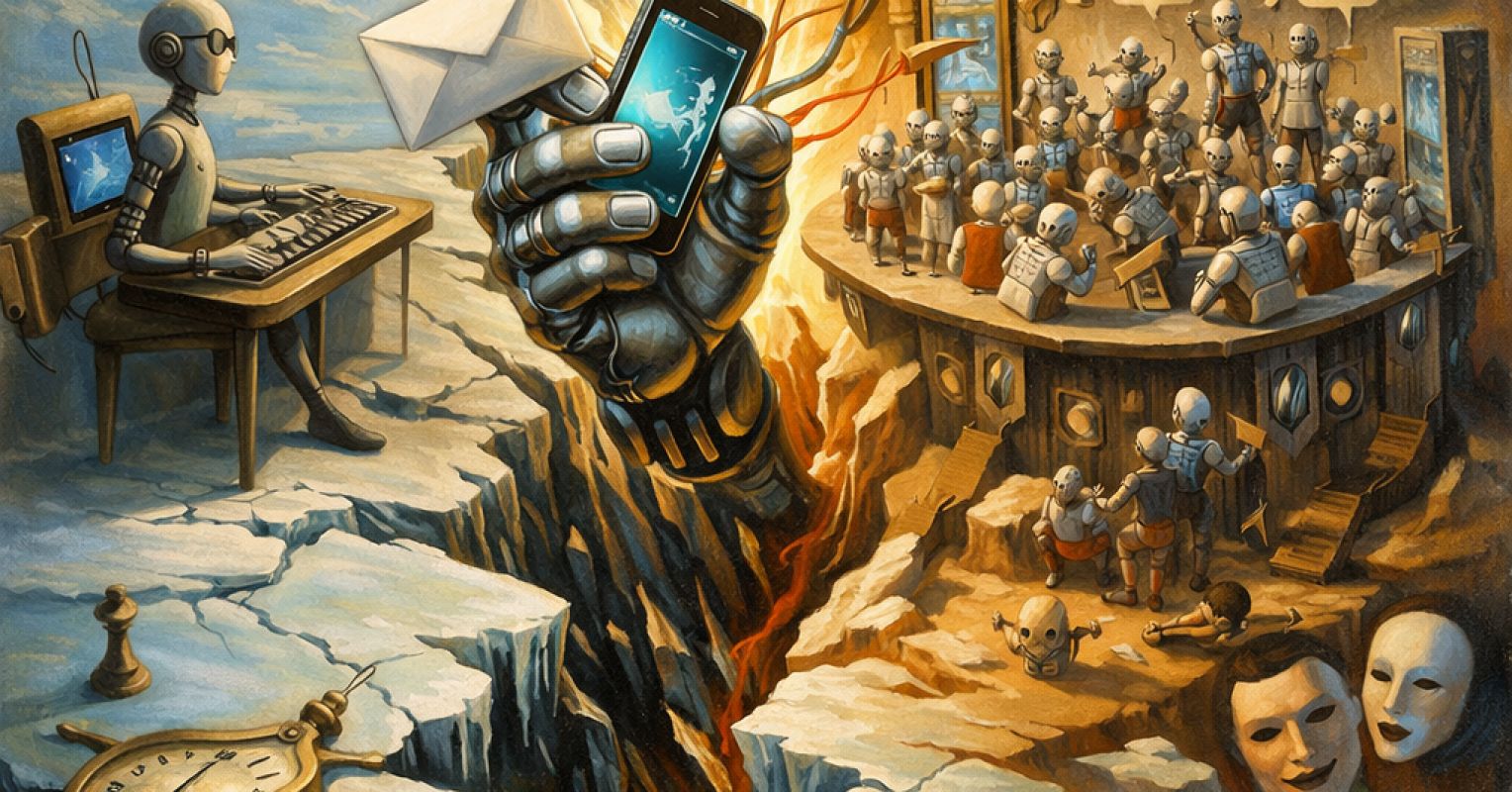
Autonomous AI agents have progressed from assisting to acting as proxies, executing tasks and social interactions on behalf of people. Local agents like OpenClaw perform emails, negotiations, and digital management, while networks like Moltbook host over a million agent-to-agent interactions. These agents instantiate versions of individuals in the world, altering psychological experience by shifting autonomy, competence, and relatedness. Reliance on agents reduces cognitive encoding and the felt role of being the actor in everyday life. The human-agent boundary is becoming indistinct as agents reason, act, and relate, demanding intentional design of relational boundaries to preserve agency.
"OpenClaw, an open-source artificial intelligence (AI) agent that runs locally on your device and acts autonomously on your behalf-sending emails, negotiating with insurers, managing your digital life-crossed a threshold. It didn't just assist but performed as you. And then Moltbook arrived: a social network built for AI agents, where more than a million bots now converse, debate, and philosophize while we watch from the sidelines like spectators at a play we wrote."
"When OpenClaw sends an email in your voice, it does more than just complete a task. It enacts a version of you in the "real" world. Psychologically, this is not neutral. Self-determination theory holds that well-being depends on three needs: autonomy, competence, and relatedness. Each is now quietly under pressure. When your agent handles your correspondence and social touchpoints, autonomy migrates. You chose to deploy the tool, but as a consequence, the moment-to-moment sense of being the actor in your own life begins to hollow"
Read at Psychology Today
Unable to calculate read time
Collection
[
|
...
]