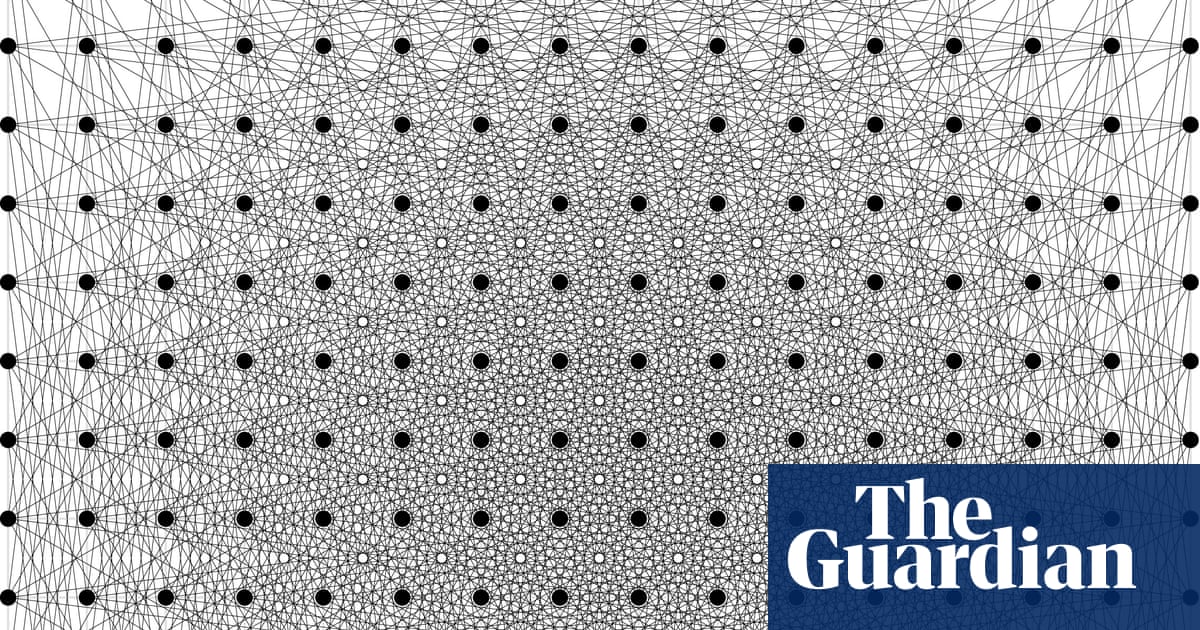
A general-purpose reasoning model produced a breakthrough on the planar unit distance problem, originally posed by Paul Erdos in 1946. The problem asks how many pairs of points on a plane can be at the same unit distance as the number of points increases. Erdos conjectured that the maximum number of such pairs grows only slightly faster than the number of points. The model instead found a new family of point arrangements that exceed that conjectured growth limit, using ideas from multiple branches of mathematics. Mathematicians validated the result, though the exact optimal growth rate remains unknown because the work only shows Erdos’s proposed limit is too low.
"The question posed by Erdos is simple to explain. If you take a sheet of paper and add some dots, how many pairs can be the same distance apart? Erdos proposed the number would rise only slightly faster than the number of dots themselves. OpenAI's model concluded otherwise by drawing on different branches of mathematics to uncover a family of arrangements that break the limit in Erdos's conjecture."
"For nearly 80 years, mathematicians believed the best possible solutions looked roughly like square grids, OpenAI wrote on X. An OpenAI model has now disproved that belief, discovering an entirely new family of constructions that performs better. While the work has excited mathematicians, the broader problem remains unsolved because the AI did not come up with a new answer for how fast the pairs of dots rise, but merely showed that the limit Erdos proposed was too low."
"OpenAI, which is preparing to float on the US stock market, said the calculations had been made by a general-purpose reasoning model which breaks down problems into smaller steps rather than a system trained specifically for mathematics. The startup has been tripped up before by its attempts to solve Erdos's problems, having hailed a supposed breakthrough last year that was in fact based on already existing literature absorbed by the model."
"This time, OpenAI's work has been validated by mathematicians, including Thomas Bloom, a mathematician who maintains the Erdos problems website and criticised OpenAI's prior Erdos claims. Bloom co-authored a companion paper to OpenAI's blog post flagging the Erdos achievement. Bloom wrote that the AI system had attained its results by persevering down paths that a human may have d"
Read at www.theguardian.com
Unable to calculate read time
Collection
[
|
...
]