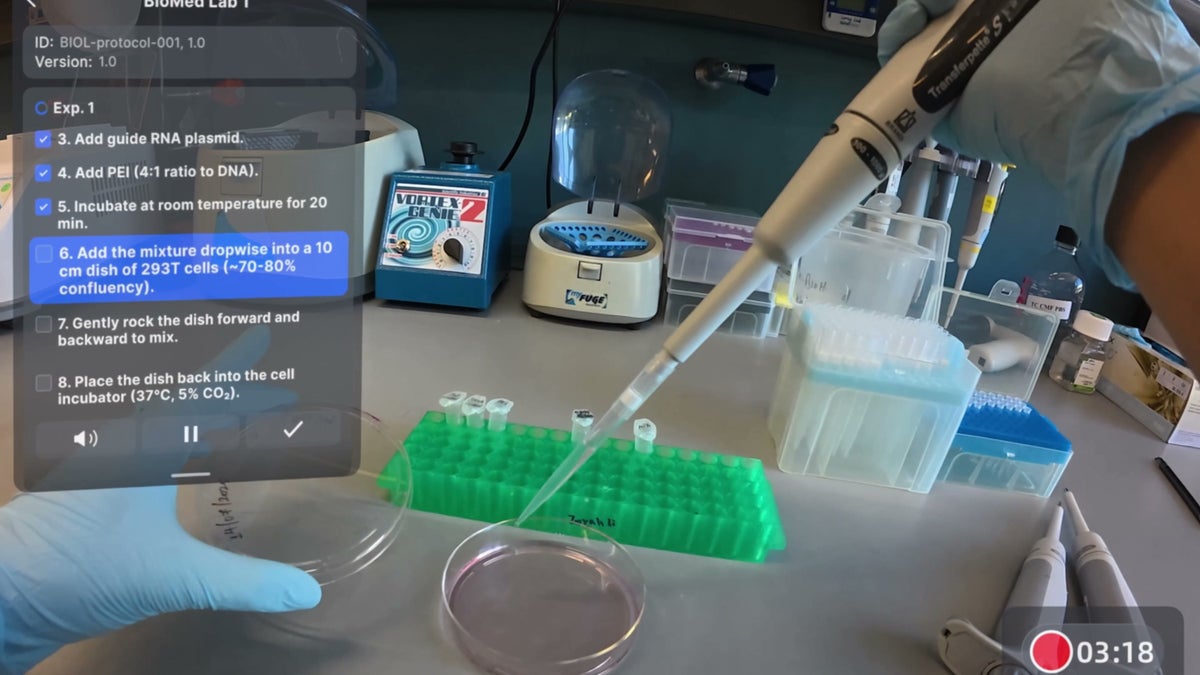
LabOS is an AI operating system developed by Stanford-Princeton AI Coscientist Team that integrates smart laboratory goggles with artificial intelligence to monitor and guide scientific work in real-time. The system uses NVIDIA's vision-language models to process visual data from cameras embedded in lab goggles, watching researchers' hands and providing immediate feedback to prevent experimental errors. By bridging the gap between physical laboratory work and digital systems, LabOS aims to rapidly train scientists to expert levels while improving experimental protocols. This innovation addresses the replication crisis, where over 70% of researchers have failed to reproduce others' experiments, by ensuring consistent, accurate execution of scientific procedures and reducing human error in laboratory settings.
"Laboratory safety goggles have finally joined the ranks of smart devices. That's the promise behind LabOS, an AI operating system for scientific laboratories built by the Stanford-Princeton AI Coscientist Team, a group led by Stanford University bioengineer Le Cong and Princeton University computer scientist Mengdi Wang, with founding partners that include NVIDIA. Powered by NVIDIA's vision-language models to process visual data, the system is designed to provide AI with real-time knowledge of lab work so it can determine what causes experiments to fail or succeed and rapidly train new scientists to expert levels by guiding them through experimental protocols."
"Walk into a wet lab, Cong says, and it hasn't changed much in the last 50 years. This matters, he explains, because a large portion of the time, science is done in the physical lab, in the physical world, not on computers. As described in a recent preprint paper, LabOS aims to bridge this physical-digital divide."
"The scientific community has long grappled with a problem that has been known for more than a decade as a replication crisis. In a 2016 Nature survey, Monya Baker, then an editor for the journal, reported that more than 70% of researchers have tried and failed to reproduce another scientist's experiments, and more than half couldn't reproduce their own work."
#ai-in-scientific-research #laboratory-automation #replication-crisis #smart-laboratory-technology #experimental-protocol-guidance
Read at www.scientificamerican.com
Unable to calculate read time
Collection
[
|
...
]