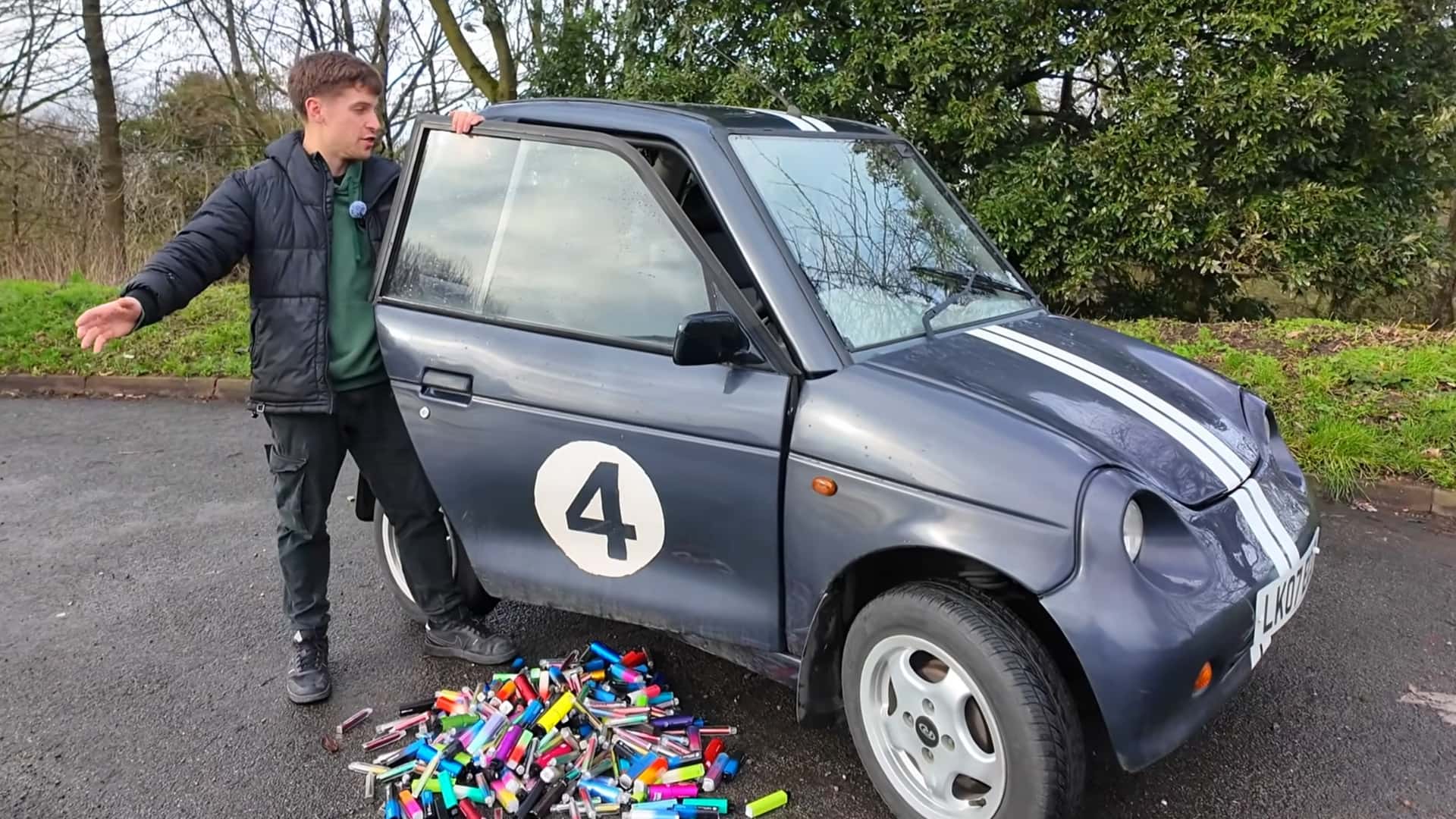
"YouTuber Chris Doel set out to prove that the cells inside disposable vapes can have a second life, and that they can even power an electric car—albeit a tiny one. He sourced no fewer than 500 individual cells, tested them to make sure they were healthy, and put them together into a makeshift battery pack."
"In the end, 14 rows were connected in series, creating a 50-volt, 2.5-kilowatt-hour battery pack. That's not a lot by modern EV standards, some of which have battery packs rated as high as 900V. But the tiny G-Wiz, which debuted in 2001, originally had a 48-volt battery pack made from 12-volt lead-acid batteries."
"To make it as safe as possible, Doel installed fuses on each cell and made good use of a battery management system that won't allow the cells to be overcharged, thus limiting the risk of a thermal event."
Millions of single-use electronic cigarettes containing functional lithium-ion batteries are discarded annually, representing significant waste. YouTuber Chris Doel extracted approximately 500 individual cells from disposable vapes, tested their health, and assembled them into a 50-volt, 2.5-kilowatt-hour battery pack using 3D-printed modular enclosures. The resulting pack matches the voltage specifications of early electric vehicles like the G-Wiz, which originally used lead-acid batteries. Safety measures including individual cell fuses and a battery management system prevent overcharging and thermal events. This project demonstrates that vape batteries retain sufficient capacity for practical reuse rather than disposal.
#battery-recycling #disposable-vape-waste #electric-vehicle-conversion #lithium-ion-cells #sustainable-energy
Read at insideevs.com
Unable to calculate read time
Collection
[
|
...
]