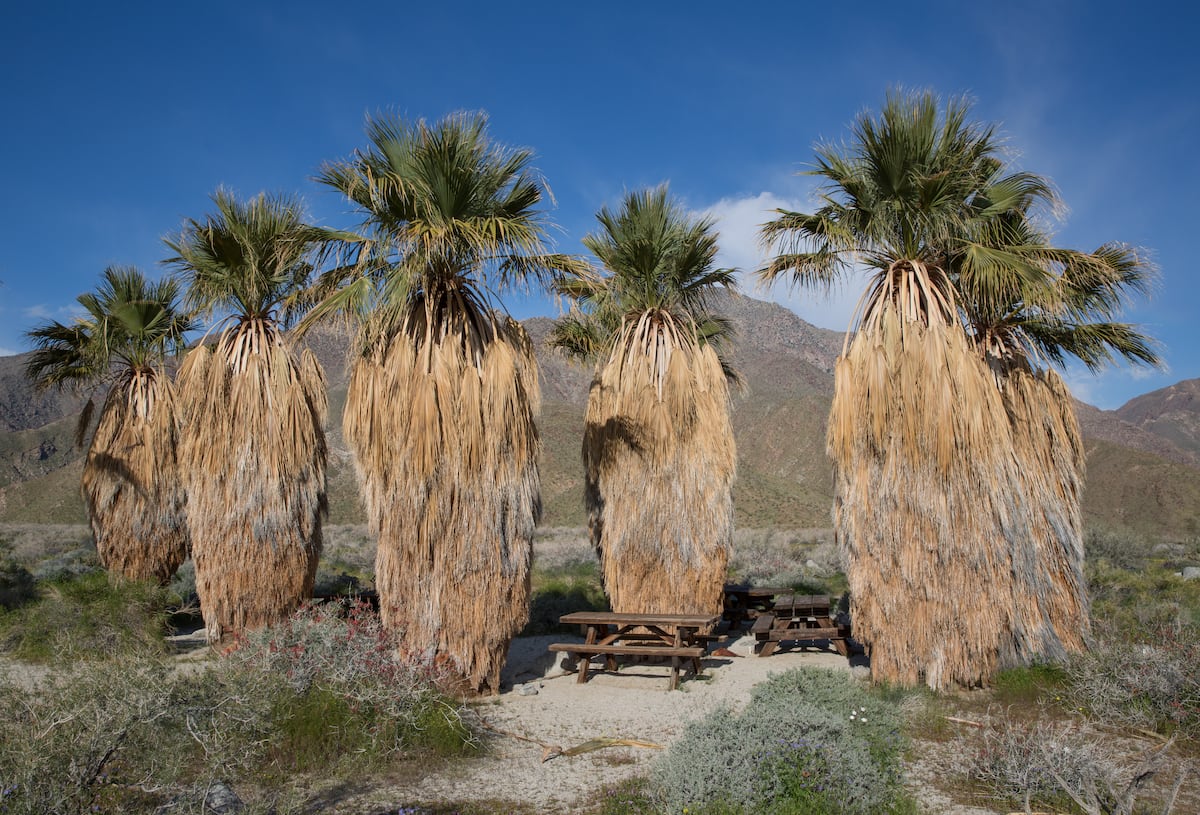
"Palms possess the elegance of simplicity: a powerful, or perhaps it is better to say graceful, trunk crowned by a crown of attractive leaves that sway in the breeze. Each palm species has its own charm, a personality that makes it recognizable among the others. To the untrained eye, many of these plants may appear identical, but with just a little attention, the differences will emerge, noticeable, for example, in their trunks more accurately called stems each with its own unique shape and color."
"All these palms are native to California and to Baja California and Sonora in Mexico. In those regions, Washingtonia palms often thrive alongside cacti of all kinds. It is generally thought, however, that there is only one species, Washingtonia filifera, which, in turn, has two main varieties: Washingtonia filifera var. robusta (the taller one), and Washingtonia filifera var. filifera. A third variety that adds to this confusion grows in the Mexican region of Sonora: Washingtonia filifera var. sonorae."
Palms present a simple graceful form with a single trunk topped by a crown of leaves. Individual palm species show distinct stem shapes and colors that aid identification. The Washingtonia group includes Washingtonia filifera with a wide stem and heights rarely exceeding 20 meters, and Washingtonia robusta with a slender stem reaching up to 30 meters. A hybrid, Washingtonia x filibusta, is also noted. These palms are native to California and to Baja California and Sonora in Mexico. Some treatments consider filifera a single species with multiple varieties. Washingtonia palms tolerate large seasonal temperature swings and resist both cold and heat.
Read at english.elpais.com
Unable to calculate read time
Collection
[
|
...
]