"It felt like walking up a mountain during a temperature inversion. You struggle through fog so dense you can scarcely see where you're going. Suddenly, you break through the top of the cloud, and the world is laid out before you. It was that rare and remarkable thing: a eureka moment. For the past three years, I'd been struggling with a big and frustrating problem. In researching my book Regenesis, I'd been working closely with Iain Tolhurst (Tolly), a pioneering farmer."
"He uses no fertiliser, no animal manure and no pesticides. His techniques, the result of decades of experiment and observation, appear to enrich the crucial relationships between crops and microbes in the soil, through which soil nutrients must pass. It seems that Tolly has, in effect, trained his soil bacteria to release nutrients when his crops require them (a process called mineralisation), and lock them up when his crops aren't growing (immobilisation), ensuring they don't leach from the soil."
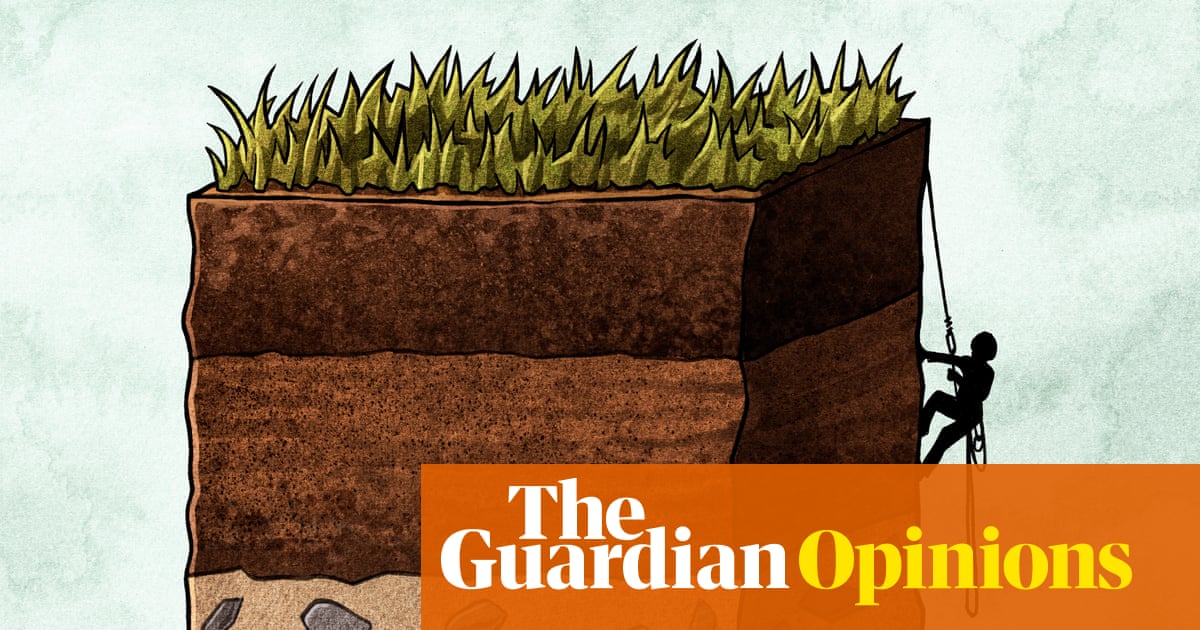
"Tolly has inspired many other growers to attempt the same techniques. Some have succeeded, with excellent results. Others have not. And no one can work out why. It's likely to have something to do with soil properties. But what? Not for the first time, I had stumbled into a knowledge gap so wide that humanity could fall through it. Soil is a fantastically complex biological structure, like a coral reef, built and sustained by the creatures that inhabit it."
A pioneering farmer developed techniques that produce high and rising yields while avoiding fertiliser, animal manure, and pesticides by enhancing soil microbial interactions. Those techniques appear to promote mineralisation when crops need nutrients and immobilisation when crops are absent, reducing nutrient leaching. Replication by others has produced mixed results, suggesting soil properties mediate outcomes. The variability indicates a major knowledge gap about soil functioning despite soil supplying 99% of human calories. Soil functions as a complex biological structure sustained by its inhabitants, and understanding the precise soil factors that enable these techniques remains crucial for scaling low-impact, high-yield agriculture.
Read at www.theguardian.com
Unable to calculate read time
Collection
[
|
...
]