Productivity
fromFast Company
1 hour agoFour steps for better focus from a cognitive scientist
Inability to focus is a major barrier to productivity, often exacerbated by self-inflicted distractions.
In response to threats by US President Donald Trump to somehow acquire Greenland (Kalaallit Nunaat), US scientists have drafted what they call a statement in solidarity with the island, open to any US-based researchers who have conducted research there. "A lot of people in the US - not just scientists - are very upset about the rhetoric directed towards Greenland. But scientists who work there feel it very personally," says paleoclimatologist Yarrow Axford, who is one of the creators of the initiative.
In behavioral science, identity follows action. If you're generous, you'll begin to see yourself as generous. If you're a patient person, you'll come to see that as part of who you are. Over time, the brain will wire itself to repeat these patterns.
The term "conspiracy theory" calls to mind a variety of dubious claims and controversies, like rumors about Area 51, claims that the Earth is flat, and the movement known as QAnon. At first blush, these phenomena would seem to have little in common with bogus word origins. But there are a variety of false etymologies that spread virally and refuse to go away, in much the same way that stories about chemtrails, black helicopters, and UFOs refuse to die.
Led Zeppelin warned us about the perils of misunderstood communications in relationships. Failing to translate what we are trying to say or do so that someone else gets it is the root of so many problems. But translation is a fantastic find when it goes right. Here are some things I've learned about translating meaning from a lifetime of speaking numerous languages, practicing a wide array of martial arts, and communicating science.
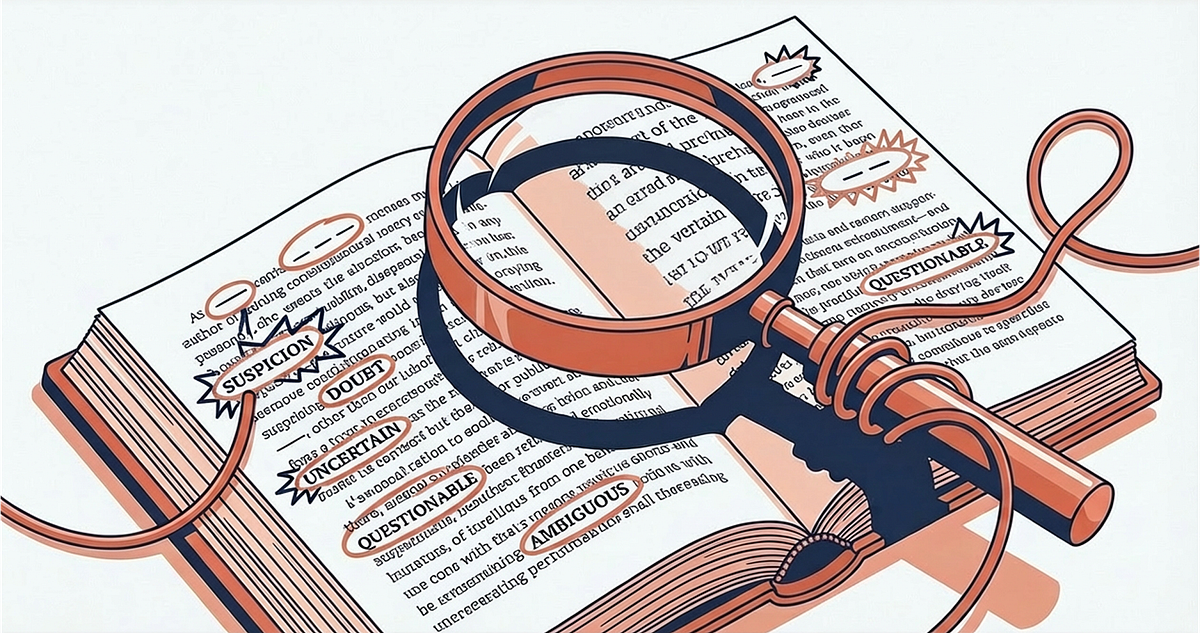
By comparing how AI models and humans map these words to numerical percentages, we uncovered significant gaps between humans and large language models. While the models do tend to agree with humans on extremes like 'impossible,' they diverge sharply on hedge words like 'maybe.' For example, a model might use the word 'likely' to represent an 80% probability, while a human reader assumes it means closer to 65%.
I'm one of those authors whose books AI ate for lunch a few years back. At some point I might get a check to pay me for a dozen years' work on the three books it stole, but really, there's no way to compensate for the fallout. AI seems to think no, it can't think, only shuffle what real people thought that a machine can write as well as a person can.
You settle in for a quick scroll through your feed, maybe just to unwind for a minute or two. But somewhere between a cooking hack and a clip you've already forgotten, forty minutes vanished. It's all a blur. Welcome to the era of infinite content and finite attention, where our brains are working overtime just to keep up with the deluge.
The human brain is engineered to ignore most of what it sees and hears, according to the neuroscientists I interviewed for the audio original Viral Voices. If that's the case, how are you supposed to make a memorable impression? The empowering news is that if you understand how the brain works, what it discards, and what it pays attention to, you'll be far more persuasive than you've ever imagined. Persuasive people have influence in their personal and professional lives.
For the first time, speech has been decoupled from consequence. We now live alongside AI systems that converse knowledgeably and persuasively-deploying claims about the world, explanations, advice, encouragement, apologies, and promises-while bearing no vulnerability for what they say. Millions of people already rely on chatbots powered by large language models, and have integrated these synthetic interlocutors into their personal and professional lives. An LLM's words shape our beliefs, decisions, and actions, yet no speaker stands behind them.
I've interviewed over 200 people for articles, from startup founders to burned-out middle managers, and I've discovered something fascinating: intellectual depth isn't about fancy degrees or knowing obscure facts. It shows up in how we communicate. When certain habits dominate someone's style, it reveals a concerning lack of curiosity and critical thinking that goes beyond just being annoying-it fundamentally limits their ability to engage with the world meaningfully.
Semantic ablation is the algorithmic erosion of high-entropy information. Technically, it is not a "bug" but a structural byproduct of greedy decoding and RLHF (reinforcement learning from human feedback). During "refinement," the model gravitates toward the center of the Gaussian distribution, discarding "tail" data - the rare, precise, and complex tokens - to maximize statistical probability. Developers have exacerbated this through aggressive "safety" and "helpfulness" tuning, which deliberately penalizes unconventional linguistic friction.
Take the sur­prise some have expressed in recent years upon find­ing out that the expres­sion to "pic­ture" some­thing in one's head isn't just a fig­ure of speech. You mean that peo­ple "pic­tur­ing an apple," say, haven't been just think­ing about an apple, but actu­al­ly see­ing one in their heads? The inabil­i­ty to do that has a name: aphan­ta­sia, from the Greek word phan­ta­sia, "image," and prefix - a, "with­out."
Most people think that sparking creativity is all about adding things[1]. They tend to think that the more they add to a particular venture or product or service, the better. More features-sure that will add to the creative element of the offering! More options? Yes, please! That will add choice, which will lead to better outcomes. We tend to associate more with being better. But when it comes to creativity, less is more.