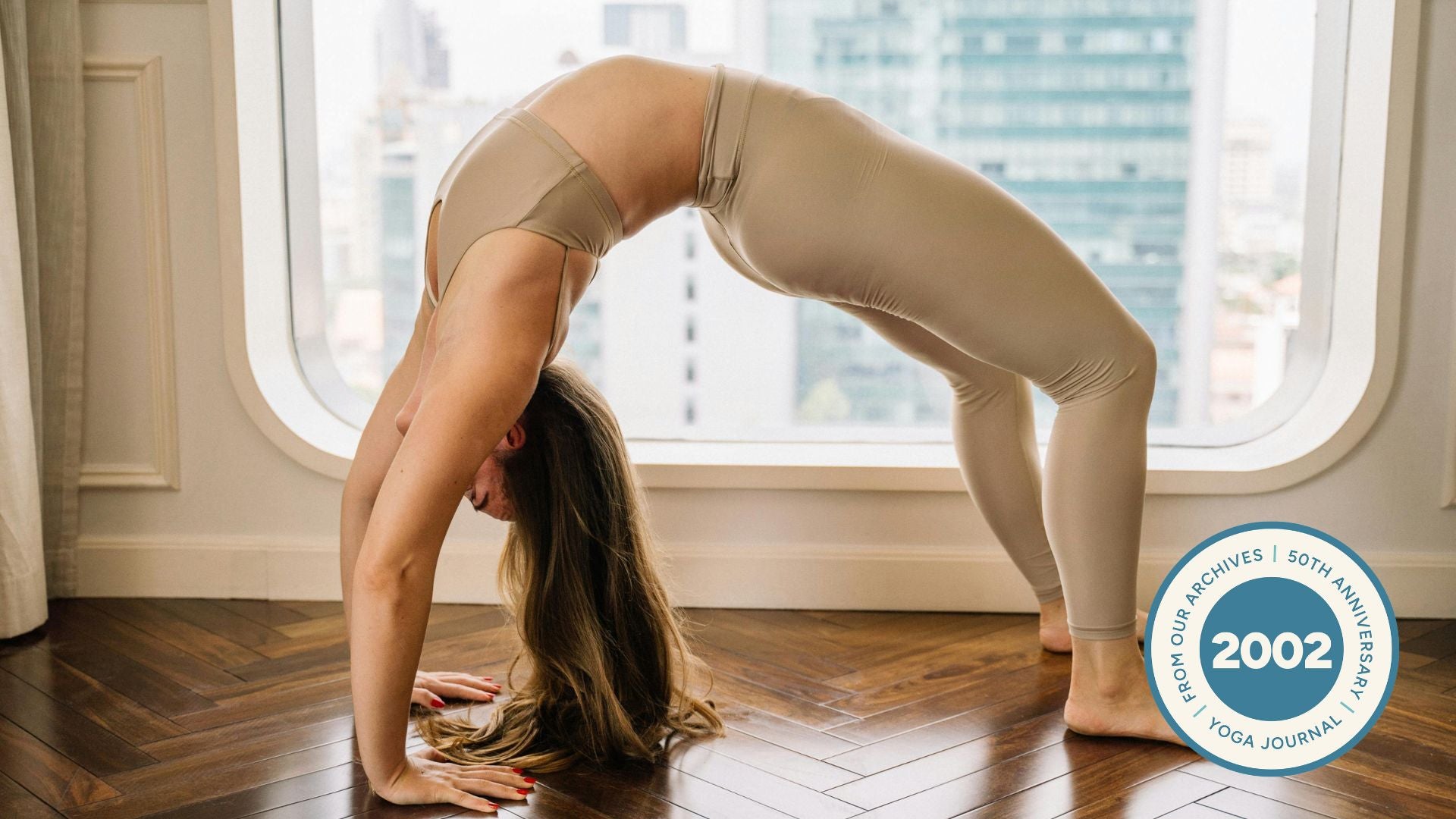
"As we work to create healthy and safe backbends-and especially as we explore deeper, more challenging backbends, like dropping back from standing into Urdhva Dhanurasana (Upward-Facing Bow Pose or Wheel Pose)-we should always seek to develop a curve of the spine that is even, with no sharp angles sticking in or out. Many students measure their progress in backbending by how extreme they can make the curves in their backs, forcing themselves into backbends before their spines are ready."
"If flexibility exists primarily in just one point of the back, that area will be very vulnerable to injury. A yoga student working with backbends is much like a carpenter working to create a curve in a fine piece of wood. Just as wood constantly overstressed in one place will eventually break, a spine overstressed in one place will eventually suffer."
Backbending should create a continuous, even curve along the entire spine with no sharp angles. Forcing extreme curvature in one spinal region jams the back, strains the sacroiliac area, and can cause long-term or irreparable damage. Folding the back nearly in half produces an impressive appearance but increases vulnerability to injury when flexibility is concentrated at a single point. Safe backbending requires warming, mobilizing, and lengthening surrounding tissues so motion distributes evenly. Individual spinal flexibility varies, so practice should work with each body's unique structure through gradual, balanced progression rather than pushing isolated extremes.
Read at Yoga Journal
Unable to calculate read time
Collection
[
|
...
]