"Since their discovery in 1967, 18 MBV outbreaks have been reported, most recently in 2024. The two known MBV species, Marburg virus (MARV) and Ravn virus (RAVV), are closely related and often not distinguished in outbreak reports. MBVs have been isolated from bats, confirming bats as their natural reservoir and suggesting long-term co-existence with human populations."
"The average case fatality rate of MBV infection is 73% (409 deaths among 563 reported human cases), markedly higher than that of EBOV, a member of the Ebolavirus genus, which averages 44% (14,881 deaths among 33,820 cases). Although two antibody-based therapies and one vaccine have been approved for EBOV, no licensed therapeutics or vaccines exist for MBVs."
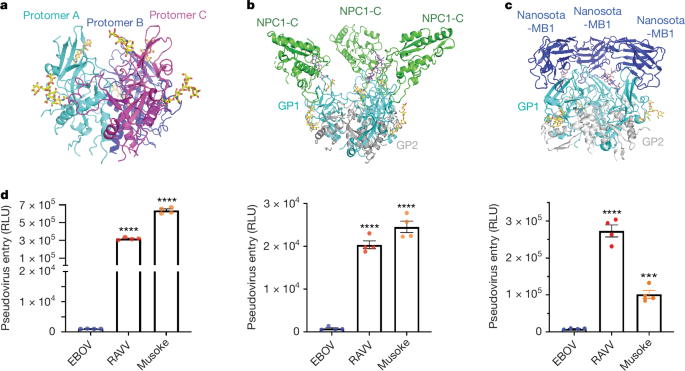
"Viral entry into host cells is a key determinant of infectivity and pathogenesis, and a major target for neutralizing antibodies. The EBOV GP, which mediates entry, has been extensively studied. On the viral surface, GP exists in a trimeric pre-fusion state composed of three copies each of the receptor-binding subunit GP1 and the membrane-fusion subunit GP2."
Marburg viruses (MBVs) are members of the Filoviridae family causing severe hemorrhagic fever with significantly higher lethality than Ebola virus. Since discovery in 1967, 18 outbreaks have occurred, with the most recent in 2024. Two MBV species exist: Marburg virus and Ravn virus. Bats serve as the natural reservoir, indicating long-term coexistence with humans. MBV infection has an average case fatality rate of 73% compared to Ebola's 44%. Despite approved antibody therapies and vaccines for Ebola, no licensed therapeutics or vaccines exist for MBVs. Understanding MBV's high lethality and developing effective countermeasures are essential for pandemic preparedness and global health security.
#marburg-virus #viral-hemorrhagic-fever #case-fatality-rate #therapeutic-development #viral-entry-mechanisms
Read at Nature
Unable to calculate read time
Collection
[
|
...
]