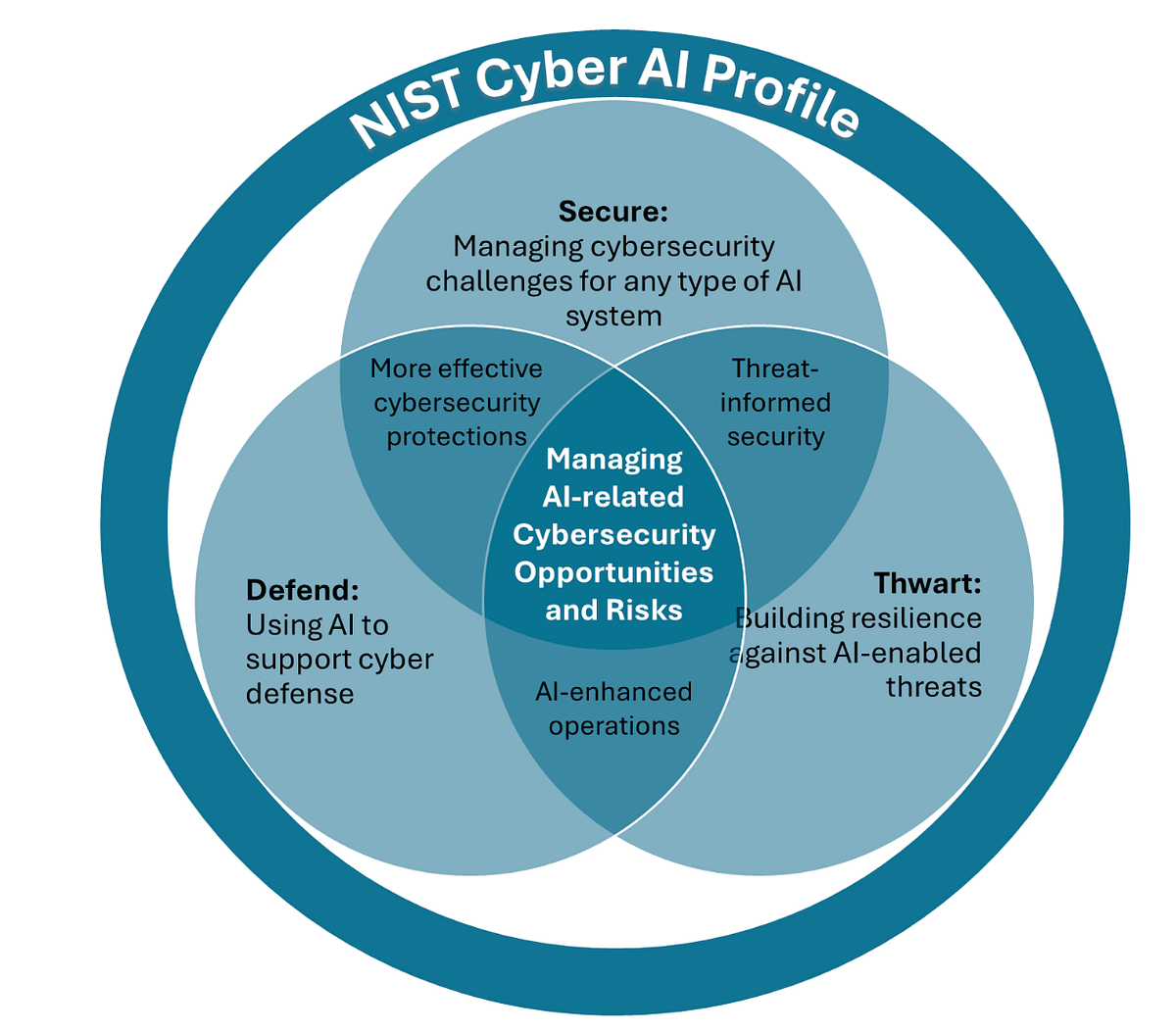
"The National Institute of Standards and Technology (NIST) recently released NIST IR 8596, the Initial Preliminary Draft of the Cybersecurity Framework Profile for Artificial Intelligence (Cyber AI Profile). The document establishes a structured approach for managing cybersecurity risk related to AI systems and the use of AI in cyber defense, organised around three focus areas: Securing AI System Components (Secure), Conducting AI-Enabled Cyber Defense (Defend), and Thwarting AI-Enabled Cyber Attacks (Thwart)."
"By analyzing how DFIR supports forensic readiness prior to deployment, accelerates detection and response during incidents, and grounds AI-enabled threats in evidence after the fact, this paper positions DFIR as essential to operationalising the Cyber AI Profile in practice. The analysis is intended to support practitioners, security leaders, and policymakers seeking to align AI adoption with accountability, observability, and defensible incident response."
NIST IR 8596 defines a Cyber AI Profile organized around three focus areas: Secure (Securing AI System Components), Defend (Conducting AI-Enabled Cyber Defense), and Thwart (Thwarting AI-Enabled Cyber Attacks). Digital Forensics and Incident Response (DFIR) is not presented as a standalone discipline but its foundational concepts are embedded across the guidance. DFIR enables forensic readiness before deployment, accelerates detection and response during incidents, and provides evidential grounding for attribution and post-incident analysis. DFIR supports accountability, observability, and defensible incident response for AI systems and AI-enabled threats. DFIR functions as a cross-cutting capability essential to operationalising the Cyber AI Profile.
Read at Medium
Unable to calculate read time
Collection
[
|
...
]