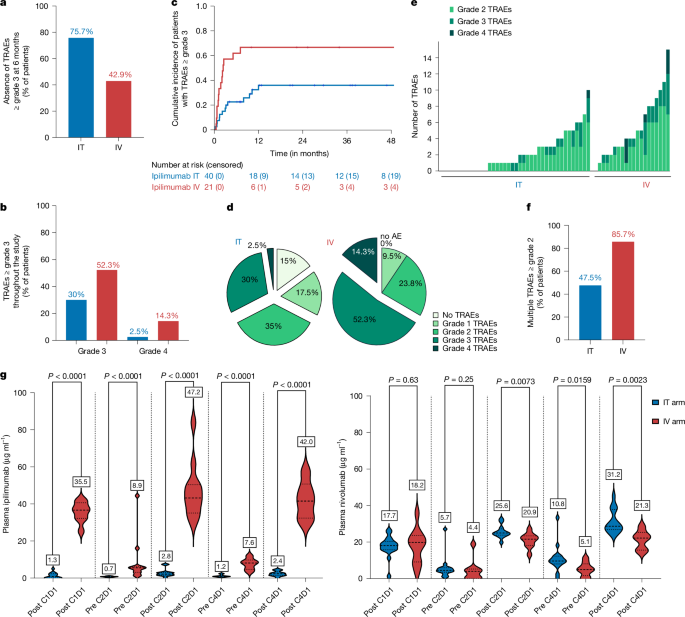
Over the last decade, metastatic melanoma treatment outcomes have improved significantly, with a 52% overall survival rate at 10 years. This progress is largely due to intravenous immunotherapies targeting CTLA4 and PD1. The combination therapy of nivolumab and ipilimumab, approved in 2015, offers higher response rates but comes with severe adverse events in about 60% of patients. Preclinical studies suggest that intratumoural delivery of low doses of anti-CTLA4 can maintain efficacy while reducing systemic exposure, showing promising results in early trials.
"Over the past decade, outcomes for metastatic melanoma have markedly improved, reaching 52% melanoma-specific overall survival at 10 years, driven largely by intravenous immunotherapies targeting the T cell co-inhibitory checkpoints CTLA4 and PD1."
"Although this combination achieves higher response rates and survival than monotherapy, it is associated with severe treatment-related adverse events in approximately 60% of patients, some of which are irreversible and 1-4% of which are fatal in real-world settings."
"Preclinical studies indicate that intratumoural delivery of low doses of anti-CTLA4 at high local concentrations can reduce systemic exposure while preserving dose-dependent antitumour activity."
"A phase 1 study in patients with stage III-IV melanoma evaluating intratumoural ipilimumab combined with intratumoural interleukin-2 showed promising activity without dose-limiting toxicity, with objective responses in 67% of injected lesions."
Read at Nature
Unable to calculate read time
Collection
[
|
...
]