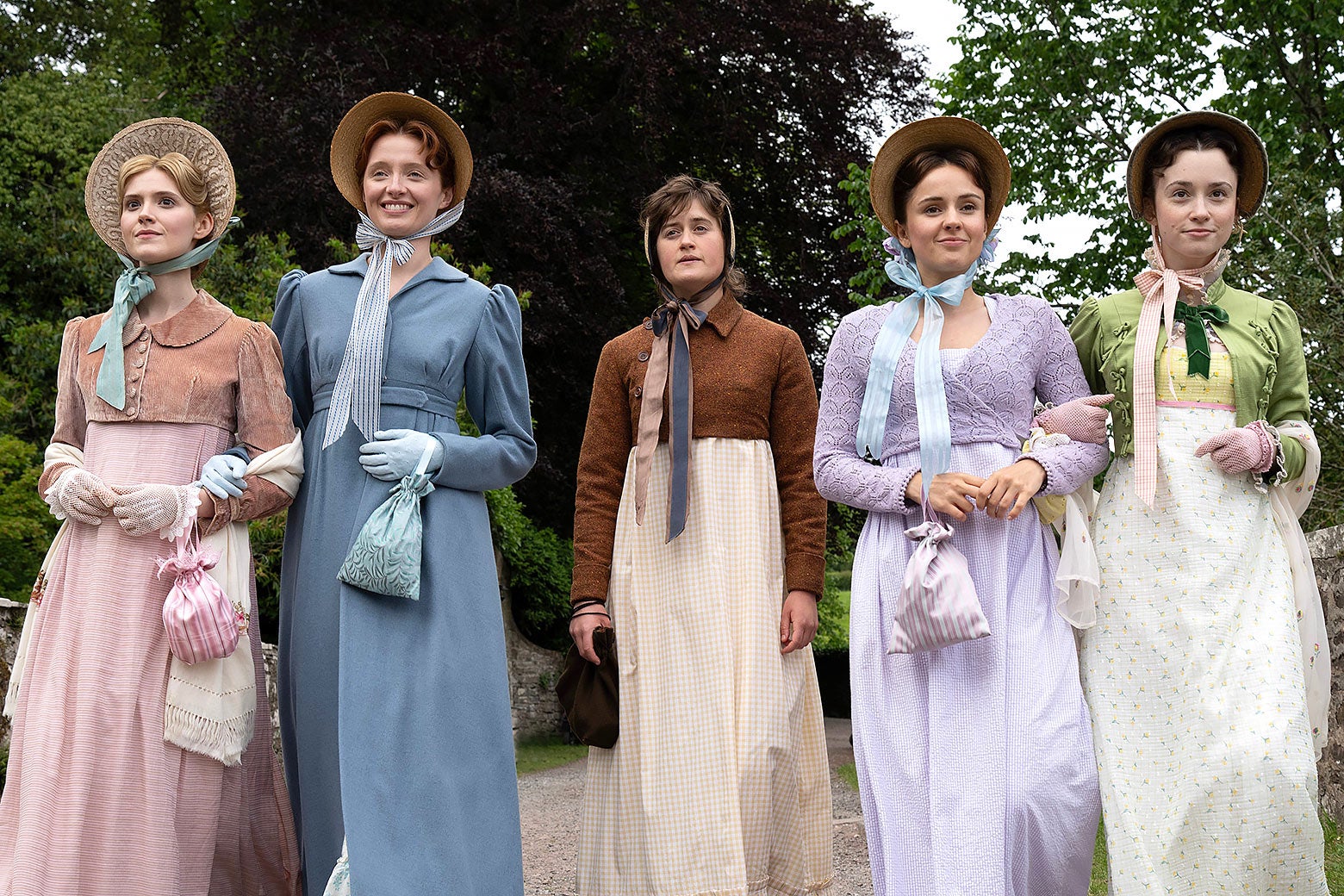
"“piqued herself upon the solidity of her reflections,” Austen writes, the “only plain one in the family” who compensates by “working hard for knowledge and accomplishments,” a person with “neither genius nor taste” whose “vanity” had “given her application” but also “a pedantic air and conceited manner.”"
"She speaks in a pompous way, as when she decides to attend a dance and says to her family: “Society has claims on us all; and I profess myself one of those who consider intervals of recreation and amusement as desirable for everybody.”"
"In the wrap-up to the novel, Austen marries off the other four sisters-beautiful Jane with Mr. Bingley, witty Lizzie with Mr. Darcy, Lydia's shadow, Kitty, with an unnamed clergyman, flighty Lydia with the wastrel Wickham-then quickly glosses over Mary's fate as Mrs. Bennet's spinster companion: “As she was no longer mortified by comparisons between her sisters' beauty and her own, it was suspected by her father that she submitted to the change without much reluctance.”"
"Janice Hadlow's 2020 bestselling novel The Other Bennet Sister-a rare work of Pride and Prejudice fanfiction, in an ever-growing library of such variations, to contain almost nothing of readers' favorite couple, Lizzie and Darcy-theorizes that Mary might have been deeply misunderstood. Mary, like the other sisters, might have found her mother absolutely awful, and might have dreaded becoming the “plain but helpful” daughter at"
Mary Bennet is depicted as the middle sister who focuses on reflections, knowledge, and accomplishments while lacking genius or taste. Her vanity and pedantic manner lead to pompous speech, including a formal justification for attending a dance. The original story resolves the other sisters’ marriages and then briefly notes Mary’s shift into the role of Mrs. Bennet’s companion after she is no longer distressed by comparisons. A later fanfiction novel proposes that Mary’s character may have been misunderstood, suggesting she could have suffered under her mother’s behavior and feared being reduced to a “plain but helpful” daughter.
Read at Slate Magazine
Unable to calculate read time
Collection
[
|
...
]