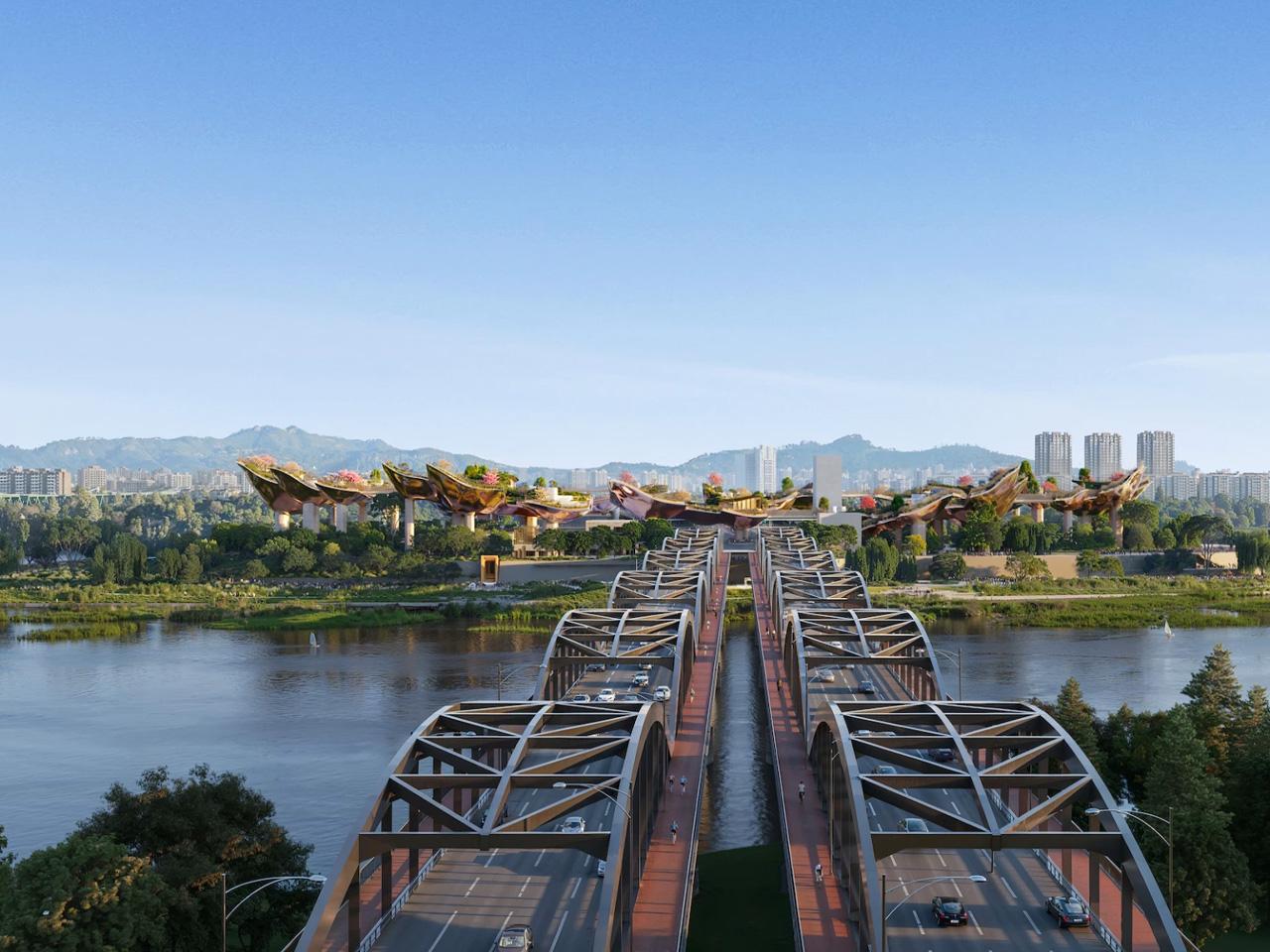
Positioned at the entrance to the future district, the building establishes a transition between planned developments to the west and the existing urban fabric to the east. The school project is organised in an L-shaped configuration along the site's peripheral boundaries. This arrangement articulates connections between adjacent neighbourhoods while structuring internal courtyards and circulation.
Standing 74 meters tall at the tip of Feijenoord Island, De Piek transforms a neglected parking lot into a vibrant waterfront hub. This residential tower brings new life to a previously overlooked industrial area in South Rotterdam, with 142 apartments and a ground-floor cafe that opens the quay to public use. Strategically positioned next to the Piek bridge, De Piek is part of a broader vision to convert the former industrial zone into a lively urban quarter blending residential, commercial, and public functions.
Design Team: GUO Wei, QIU Mei, HE Chunyao, LIU Qian, WU Qijing, TANG Runen, CHEN Jiannan, GONG Chenxi, DENG Jian, ZHOU Duchuang(Intern), WEI Zhichao(Intern), JI Jiahui(Intern), WU Tianrong(Intern) Clients: Kunshan Yangcheng Lake Science Park Co., Ltd. Intelligent Design: Jiangsu NETIN Technologies Co, Ltd Text description provided by the architects. This increasingly complex project emerged from an interactive process and key breakthroughs by both the government and architects - through ongoing coordination and integration, architects drive the joint renewal of urban and educational spaces.
Adaptive reuse allows architects to conserve resources, reduce waste, and extend the life of existing structures. By working with what already exists, architects lessen the need for new materials, lower energy consumption, and limit demolition debris. This approach protects natural habitats and green spaces by reducing the demand for new land development. Through reuse, cities become more sustainable and less carbon-intensive while preserving the material and cultural value of the built environment.
"It's incredibly transformed," says Emily Mueller De Celis, a landscape architect at the firm Michael Van Valkenburgh Associates, which won a competition to "renaturalize" the area in 2007. "Rather than walking around in and amongst oil refineries and other industry, now you are immersed in nature, walking along the banks of a river with spectacular views back to the city."
I am not prepared to say that all the Black artists in Portland have opportunities to offer all they have to give. But in this predominantly white city whose Black community has faced so many challenges of displacement and harm, Black artists - both local and folks with whom our local artists have built relationships - demonstrate the resourcefulness and tenacity and brilliance required to continue to offer this community great theatrical work illuminating the experience of the Black diaspora.
The Atlantic Avenue Murals celebrate the people who make their neighborhood and a neighborhood that shapes its people. The artwork highlights the gateway's ebullient use today as a gateway for families, dogs, shoppers and travelers, transforming a once desolate underpass into a vibrant community space.
In its current form, the site has been reconfigured using salvaged elements to create seating, shelter, and gathering space, addressing the lack of public infrastructure in Frihamnen.
Tong Ho Chung Howard emphasizes the importance of capturing Hong Kong's historical architecture, specifically corner houses, which are being replaced by modern developments, diminishing the city's uniqueness.