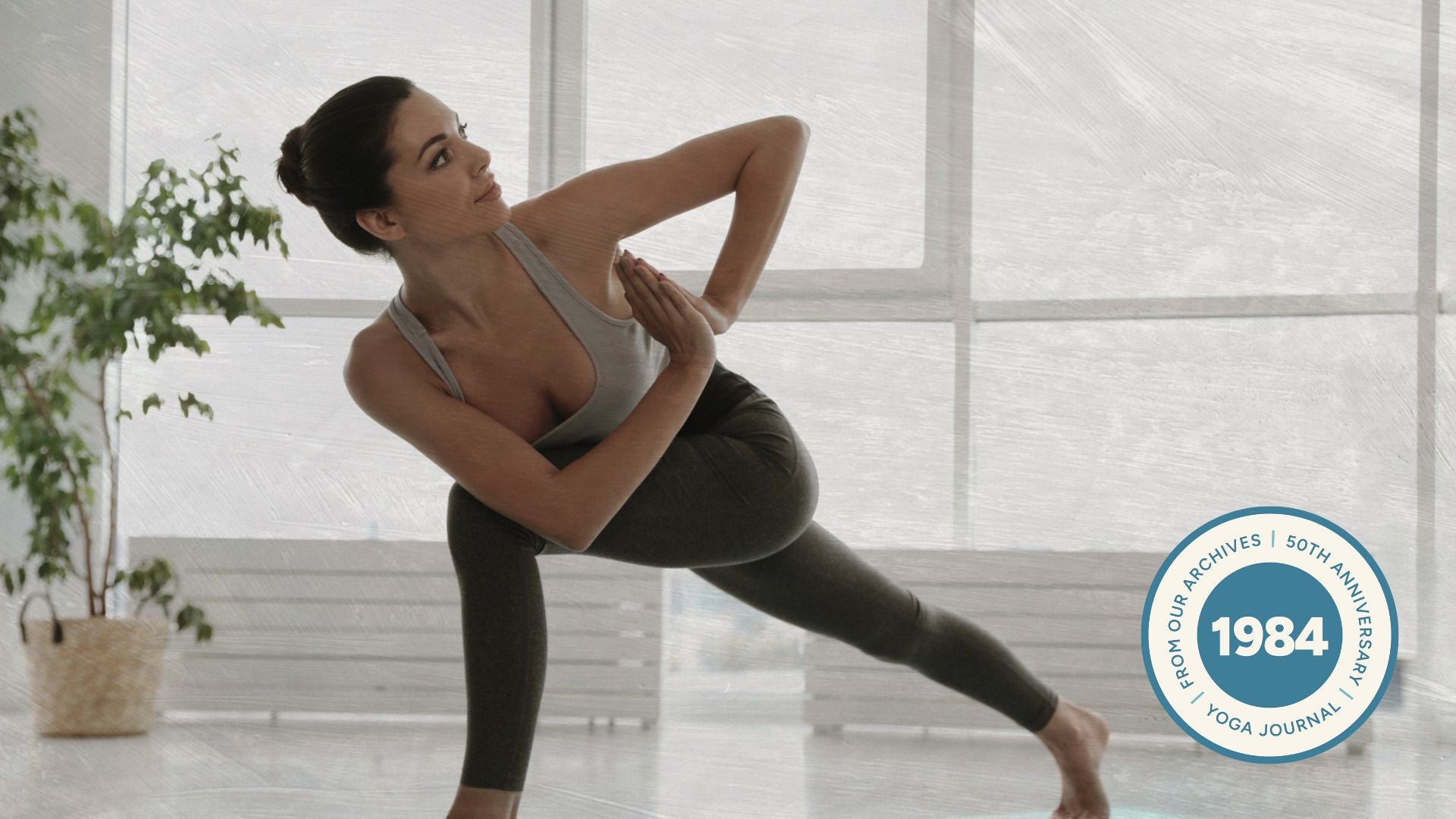
Revolved Side Angle Pose involves a twist that increases difficulty and places strong influence on the spinal column. The pose demands exact leg awareness; loss of stretch or incorrect back-leg rotation collapses the posture and prevents a correct twist. Twisting stretches the small intrinsic spinal muscles while compressing intervertebral discs, so maximal spinal elongation during the twist is essential to avoid imbalances. The twist should remain relaxed rather than forced by the arm crossing the knee. Freeing the diaphragm and allowing the spine to assume the twist prevents aggressive, preconceived forcing and supports safer, more effective practice.
"Revolved Side Angle Pose ( Parivrtta Parsvakonasana) is more difficult than most other standing poses and has a more powerful effect upon the spinal column. This pose requires tremendous awareness of the legs. If the stretch on the back leg is lost, the entire pose collapses. If the leg over-rotates, the knee bends, and if it under-rotates, no twist is possible. To create the proper twist, the student must learn to turn the back knee out while rotating the pelvis in the opposite direction."
"The twist itself should feel somewhat relaxed. This means that the arm crossing the knee should not be used aggressively to force the twist. Rather, the student should concentrate on elongating the spinal column and freeing the diaphragm. If the diaphragm is compressed by the ribs, twisting will be difficult. One should allow the spine to assume the twist rather than forcing the body into a preconceived position. This principle is an important one in the whole practice of yoga."
#parivrtta-parsvakonasana #twisting-asanas #spinal-health #alignment--leg-awareness #mindful-practice
Read at Yoga Journal
Unable to calculate read time
Collection
[
|
...
]