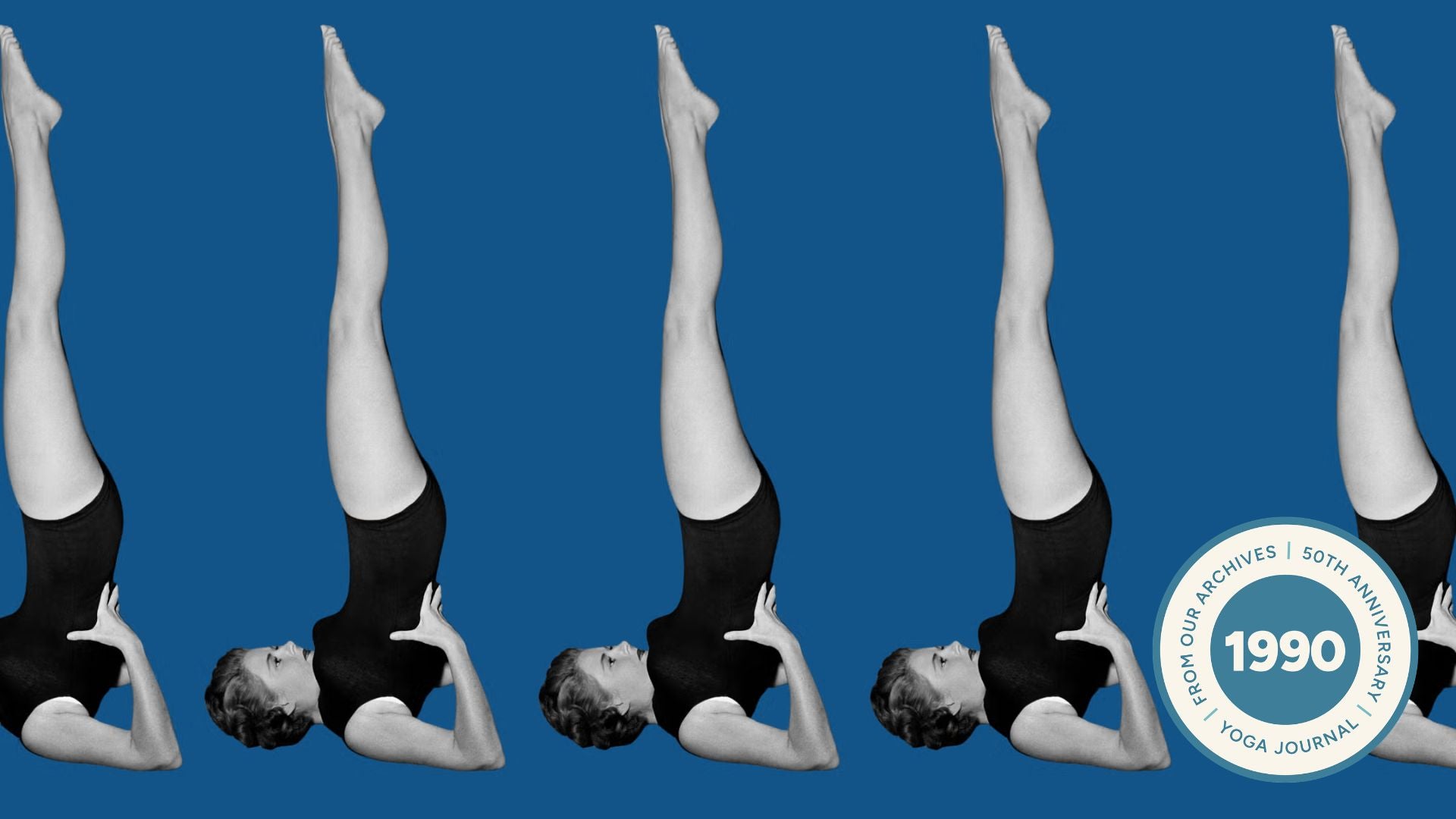
"To understand the essence of any posture, we must return to Mountain Pose (Tadasana), from which all the other asanas derive. First we must ask ourselves: What is the natural action of the body in a proper Mountain Pose, and what postural distortions have I accumulated that inhibit this natural action? Then we need to ask: What additional distortions might arise as a result of the new relationship between body and gravity introduced in Shoulderstand?"
"In a well-balanced Mountain Pose, each bone in the body is centered and evenly spaced in relation to all contiguous bones. This centering affords the joints maximum movement and stability and frees the muscles to contract and release efficiently. In a healthy, undistorted body, the muscular action follows certain patterns. In some areas, the muscles naturally tend to lift; in other areas, they tend to pull downward."
Shoulderstand requires patience, preparation, and restoration of natural alignment to avoid neck, head, and circulatory problems. The practice begins by reestablishing the Mountain Pose pattern of centered, evenly spaced bones so joints gain stability and muscles can contract and release efficiently. Practitioners must identify accumulated postural distortions that inhibit natural muscular action and anticipate distortions introduced by inversion and gravity. Preparation includes progressive steps, props, and adaptations that recreate the Mountain action within Shoulderstand. When muscular action is unobstructed, a wave of postural energy follows predictable pathways, particularly along the spinal column.
Read at Yoga Journal
Unable to calculate read time
Collection
[
|
...
]