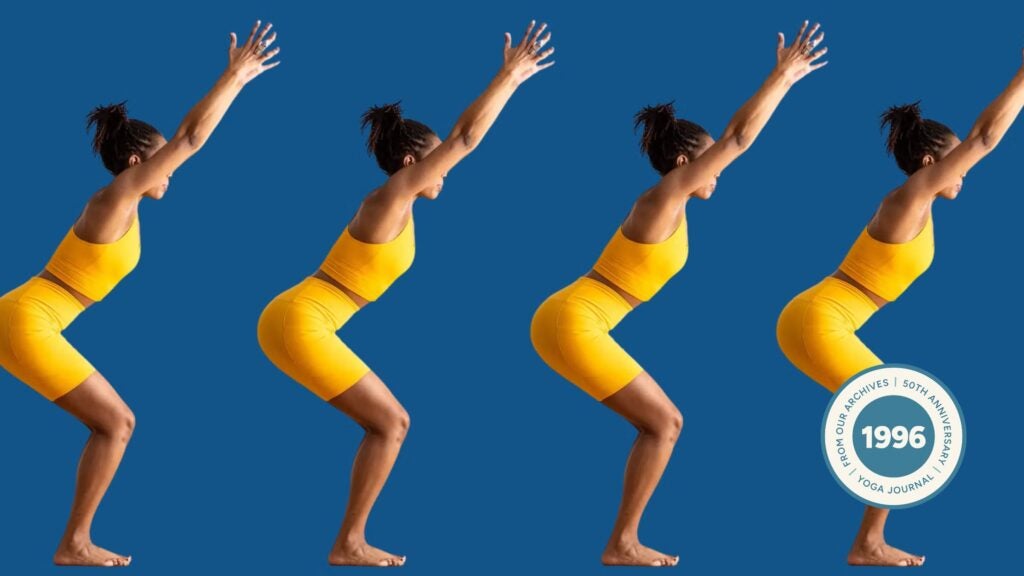
"Though there are as many asanas as there are species of living creatures in the universe, the old hatha yoga manuals report there are just 32 that are beneficial for humans, and Chair Pose is included among them. Chair is essentially a half-squat, or a half-stand: The feet are flat on the floor, the shins are angled forward about 45 degrees over the feet, the thighs are almost parallel to the floor, and the torso stretches up and back with the arms reaching upward."
"Thomas Hanna points out that life, far from being dragged down by gravity, uses its energy as an evolutionary springboard; it is, he writes, a 'supportive force' that frees all life to develop and advance, from the oceans onto land, from land into the air and, I suppose, beyond the Earth to other alluring worlds."
"We're able to stand up to gravity, of course, because we have a sturdy interior chassis, a skeleton, that's designed to bear and control our weight. Our bones separate and rig our muscles to maintain their balanced tone and skillful action."
Chair Pose, though often disliked by students, ranks among the 32 beneficial asanas documented in traditional hatha yoga manuals. The pose involves a half-squat position with feet flat, shins angled forward approximately 45 degrees, thighs nearly parallel to the floor, and the torso stretched upward with arms reaching overhead. Gravity functions as a supportive evolutionary force rather than a burden, enabling life to develop and advance. The human skeleton provides the structural framework necessary to bear and control body weight against gravity. Proper bone alignment is essential for maintaining balanced muscle tone and skillful movement, making Chair Pose valuable for developing this fundamental relationship with gravitational forces.
Read at Yoga Journal
Unable to calculate read time
Collection
[
|
...
]