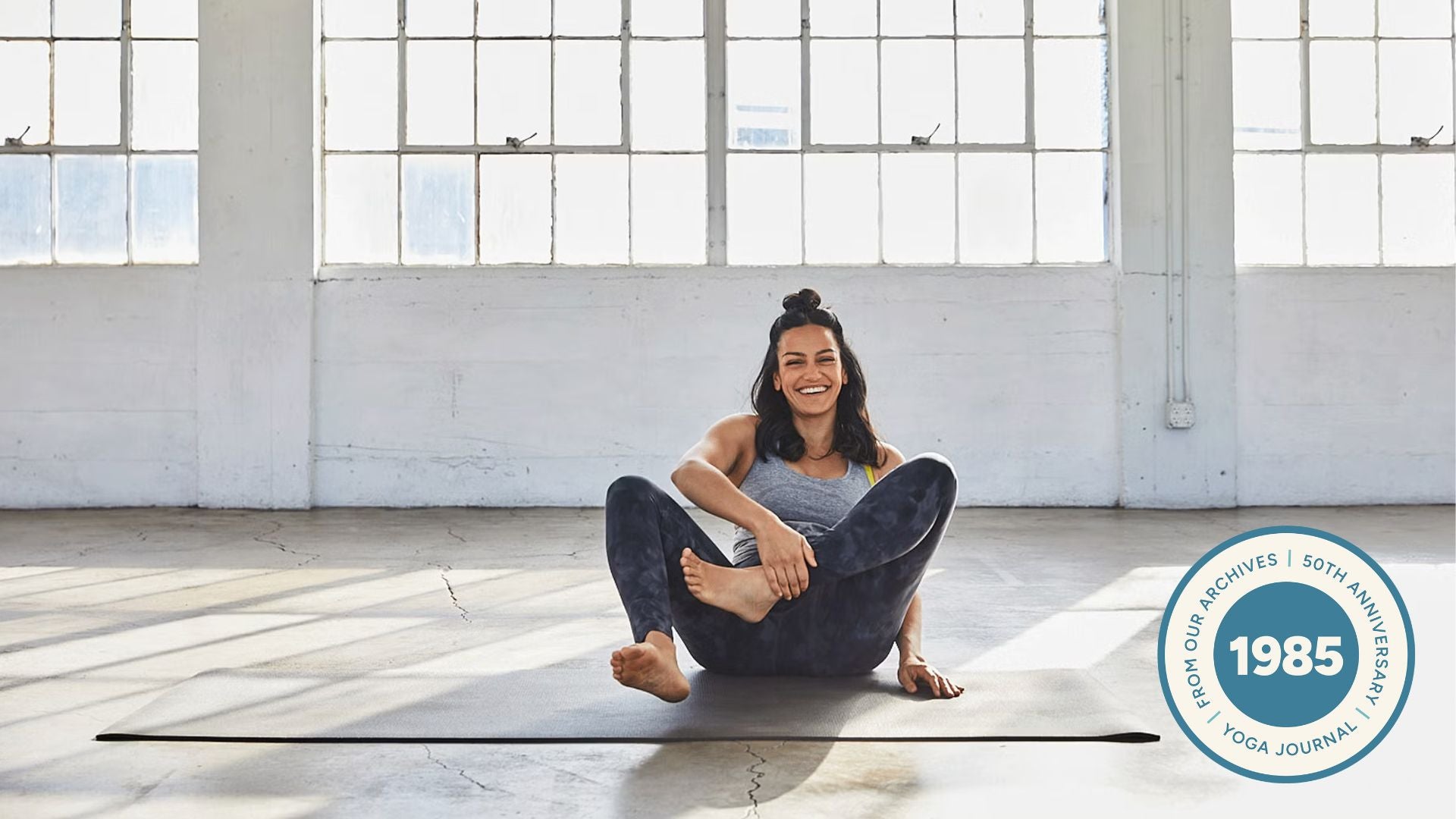
"Half-Bound Lotus Forward Bend, as the Sanskrit name of this pose translates to, involves a stretch for the straight leg as well as the opposite hip joint, the spine, and the arm that encircles the body. Like all forward bends, Ardha Baddha Padma Paschimottanasana requires flexibility in the hamstring muscles of the thigh. As these muscles along the back of the leg are gradually stretched, the pelvis can more easily tip forward, allowing the vertebral column to remain in a virtually neutral position."
"If a forward bending asana like this one is practiced in such a way that the inward curve in the lumbar spine (lower back) is reversed, the soft tissues-discs, ligaments, tendons, and muscles-are stressed and strain to the lumbar area is likely. If the normal lumbar curve is maintained, there is minimal stress and the pose does not disturb the body but rather enhances its structure."
"The lumbar curve, as well as the other curves of the column-the inward curve of the cervical spine (neck), the outward curve of the thoracic spine (midback), and the outward curve of the sacrum (near the buttocks)-should be maintained as much as possible in all movements. In forward bending, then, one should bend from the hips, disturbing the lumbar, thoracic, and cervical curves as little as possible. As soon as these curves are disturbed, the spine is actually shortened. Thus, to maintain the maximum length of the column, the curves should, whenever possible, be enhanced and maintained."
Half-Bound Lotus Forward Bend stretches the straight leg, the opposite hip joint, the spine, and the encircling arm while demanding hamstring flexibility. Gradual hamstring release permits the pelvis to tip forward so the vertebral column can stay nearly neutral. Reversing the lumbar inward curve during forward bends stresses discs, ligaments, tendons, and muscles and can cause lumbar strain. Preserving the normal lumbar curve minimizes stress and can enhance structural integrity. The lumbar, cervical, thoracic, and sacral curves should be maintained in movement by hinging from the hips to keep the spine long, reduce strain, and foster mindful awareness.
Read at Yoga Journal
Unable to calculate read time
Collection
[
|
...
]