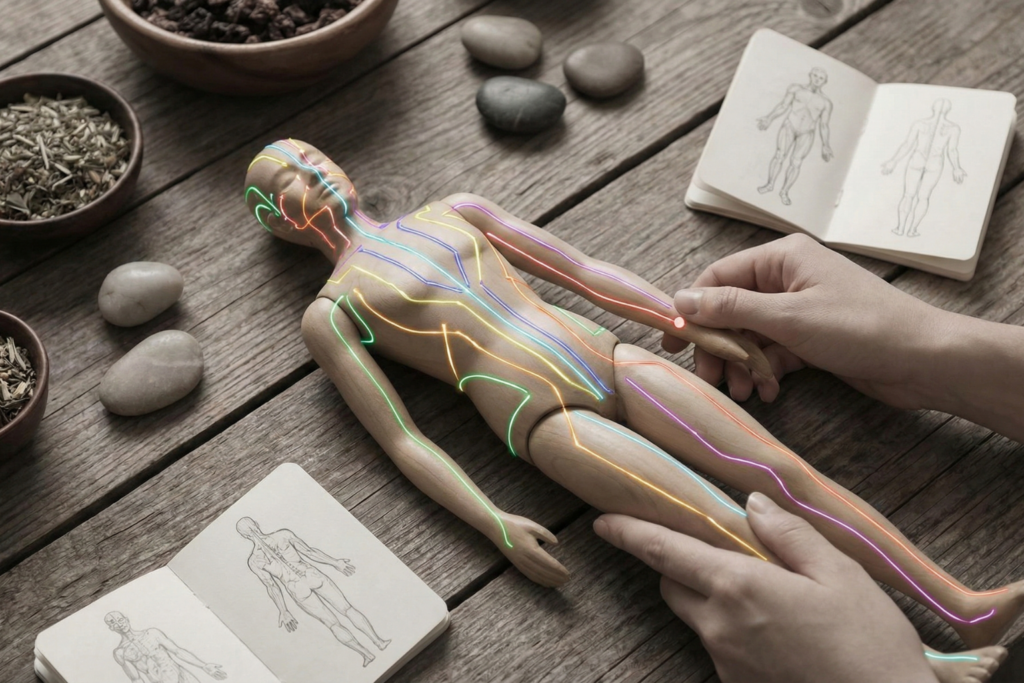
"Acupressure is based on the idea that the body functions through flow, not only structure. Traditional Chinese Medicine calls this flow Qi, while yogic science calls it Prana.The pathways that carry this movement are known as meridian lines. By stimulating specific points along these channels, acupressure influences circulation, nerves, organs, and emotional state at the same time. Understanding meridians helps explain why touching one area of the body can affect another."
"The meridian system is a network of channels running throughout the body that connects surface points with deeper physiological processes. Each pathway corresponds to an organ system and regulates both physical and emotional balance. There are twelve primary meridians forming a continuous circuit. They exist in Yin and Yang pairs. Balanced flow supports health. Disruption produces symptoms. Each meridian relates to an organ system, but the meaning of organ here is functional rather than purely anatomical. It includes physical activity, emotional tendencies, and regulatory patterns. Stimulating a meridian influences both physiology and psychology simultaneously."
Acupressure works on the premise that bodily function depends on flow (Qi/Prana) traveling along meridian lines rather than solely on structure. Twelve primary meridians form a continuous yin–yang paired circuit that links surface points to deeper physiological and emotional processes. Energy in each meridian peaks for about two hours in a 24-hour cycle, for example the Lung meridian from 3am to 5am. The full energetic network includes two central channels and eight extraordinary vessels, but practice mainly uses the twelve primaries and the central channels. Over 360 classical points exist, with some acting as master regulators of circulation, nerves, organ rhythm, and emotional balance.
Read at YOGMAY
Unable to calculate read time
Collection
[
|
...
]