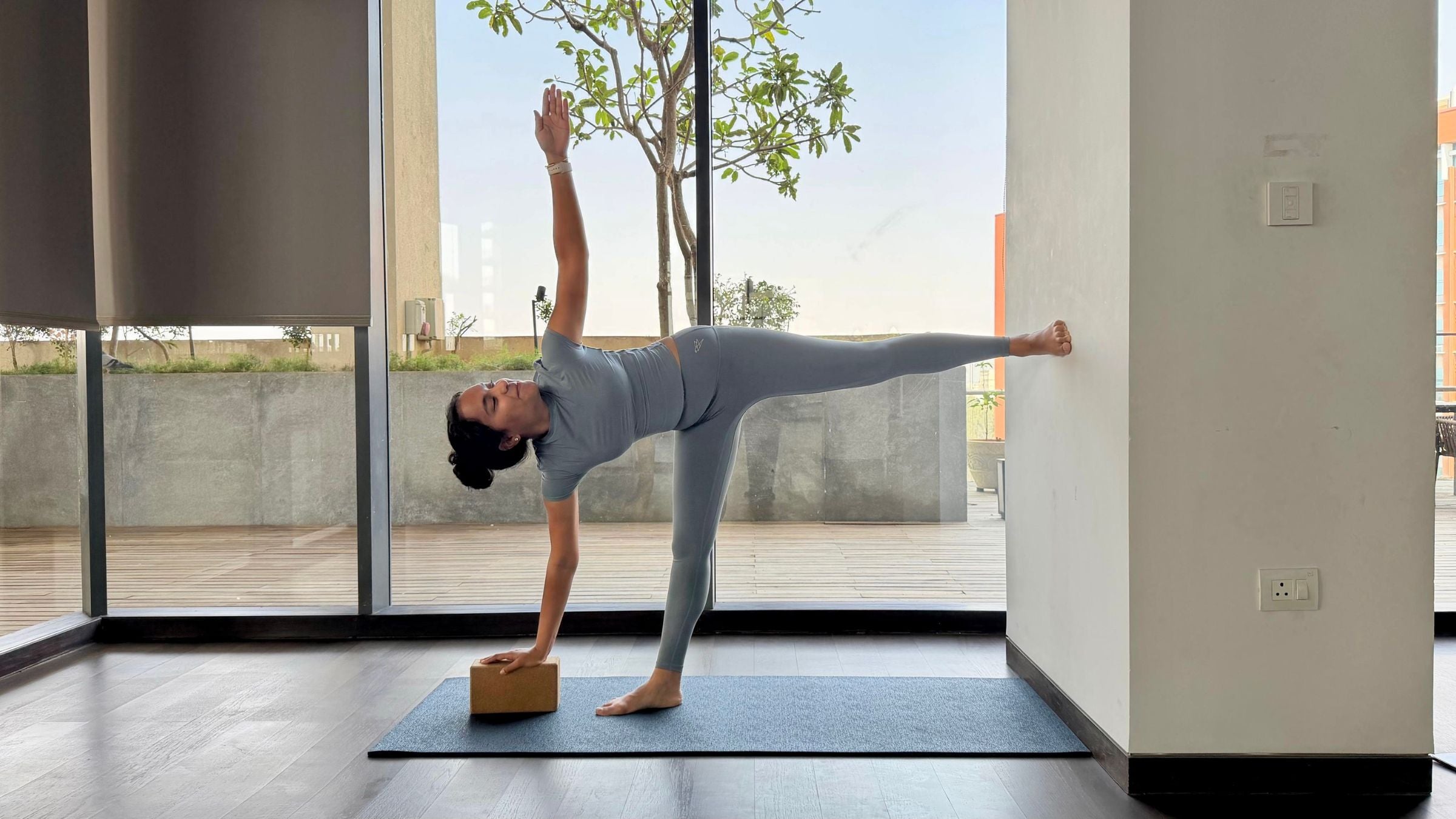
"Instead of guessing where your body is in space, you receive immediate physical feedback when you rest or press part of your body against the support. Practicing poses against a wall can reduce the intensity of a pose. But it can also increase the challenge. A wall isn't just a 'make the pose easier' prop."
"Practicing with a wall refines alignment in ways that a free-standing practice sometimes cannot. It helps you understand what true 'stacking' feels like-head over ribs and ribs over hips-which helps reduce unnecessary strain in certain poses. Pressing into a stable surface also activates your stabilizing muscles, which improves shoulder and hip mechanics."
"The wall can also help you stay in postures longer without collapsing your weight into joints. Those longer holds build strength, awareness, and endurance. Over time, this awareness carries into life, where posture, balance, and joint integrity matter just as much as flexibility."
Using a wall as a yoga prop offers precise alignment feedback that sensation alone cannot provide. Intensity in a pose does not guarantee proper form; practitioners may collapse into joints or fail to engage muscles correctly. Wall support, rooted in B.K.S. Iyengar's teachings, helps students experience true alignment and stability. Pressing against a wall activates stabilizing muscles, improves shoulder and hip mechanics, and allows for longer holds that build strength and awareness. The wall reduces unnecessary strain by promoting proper stacking of body segments and prevents weight collapse into joints. This practice develops postural awareness that extends beyond yoga into daily life.
Read at Yoga Journal
Unable to calculate read time
Collection
[
|
...
]