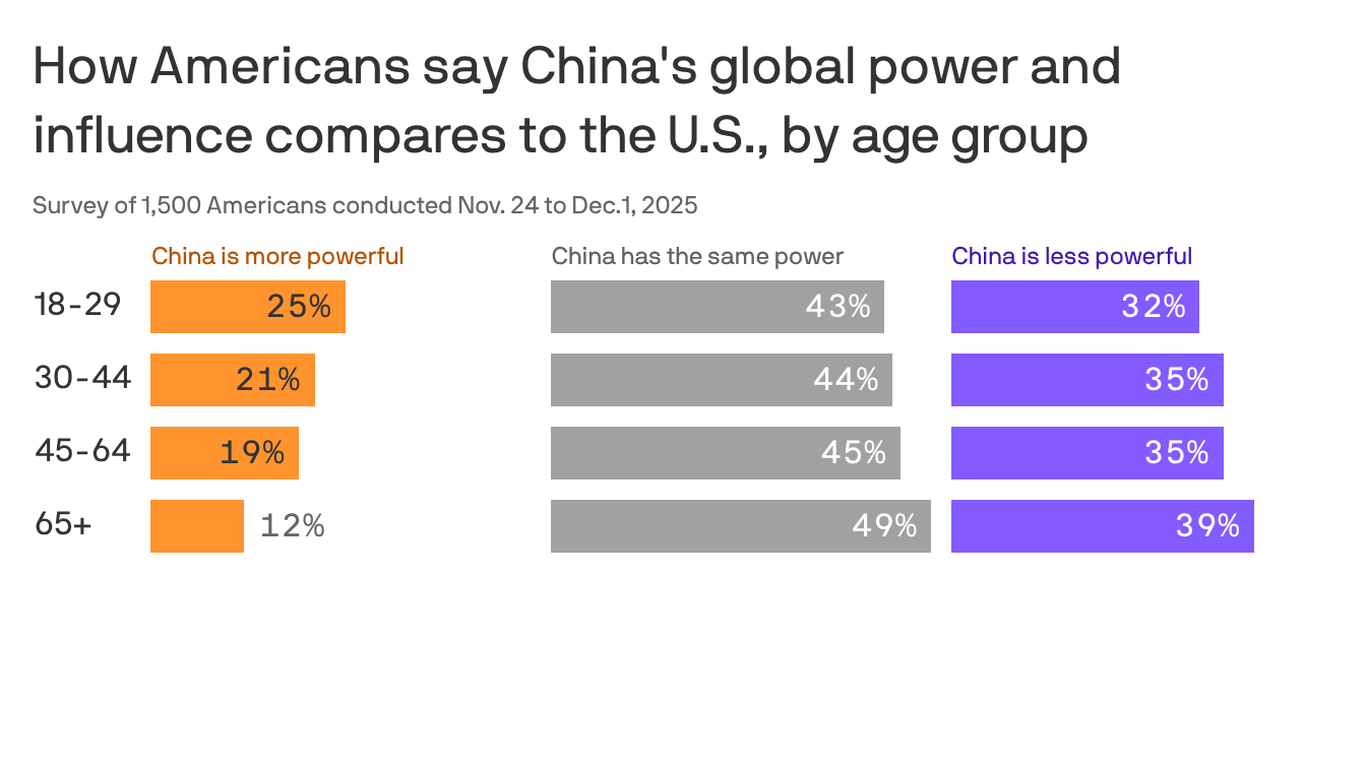
Younger Americans are increasingly less likely to view the U.S. as uniquely exceptional and are comparing U.S. policies with foreign models. Intercultural communication and travel expose young people to welfare programs and public services abroad, with European health care seen as cheaper and producing better outcomes. Young people encounter China through cultural and technological touch points like Labubu dolls and TikTok rather than as a national security threat. Many prioritize kitchen-table concerns including a weak entry-level job market, inflation squeezing wallets, and frustration with a fractured political system. Polling shows large shares across age groups view China as equal or more powerful than the U.S.
"China is increasingly not the big, bad wolf in the eyes of young people, who are encountering the country through cultural touch points like the ugly-but-cute Labubu dolls and innovations like TikTok rather than national security threats. They're more focused on kitchen table issues such as a discouraging job market for entry-level workers, inflationary pressures pinching their wallets and the growing sense that America's fractured political system doesn't work for them."
"Older Americans who came of age during the Cold War are more likely to harbor deep grievances toward Chinese aggression, and are generally more financially secure. "We have that binary that the U.S. represents capitalism and China represents socialism," Jake Werner, director of the East Asia Program at the Quincy Institute tells Axios. "The promise of capitalism that was really compelling to people in the 80s and 90s, it's kind of gone into reverse. Some of it might come from the sense that grass is always greener on the other side, which is not actually realistic.""
Read at Axios
Unable to calculate read time
Collection
[
|
...
]