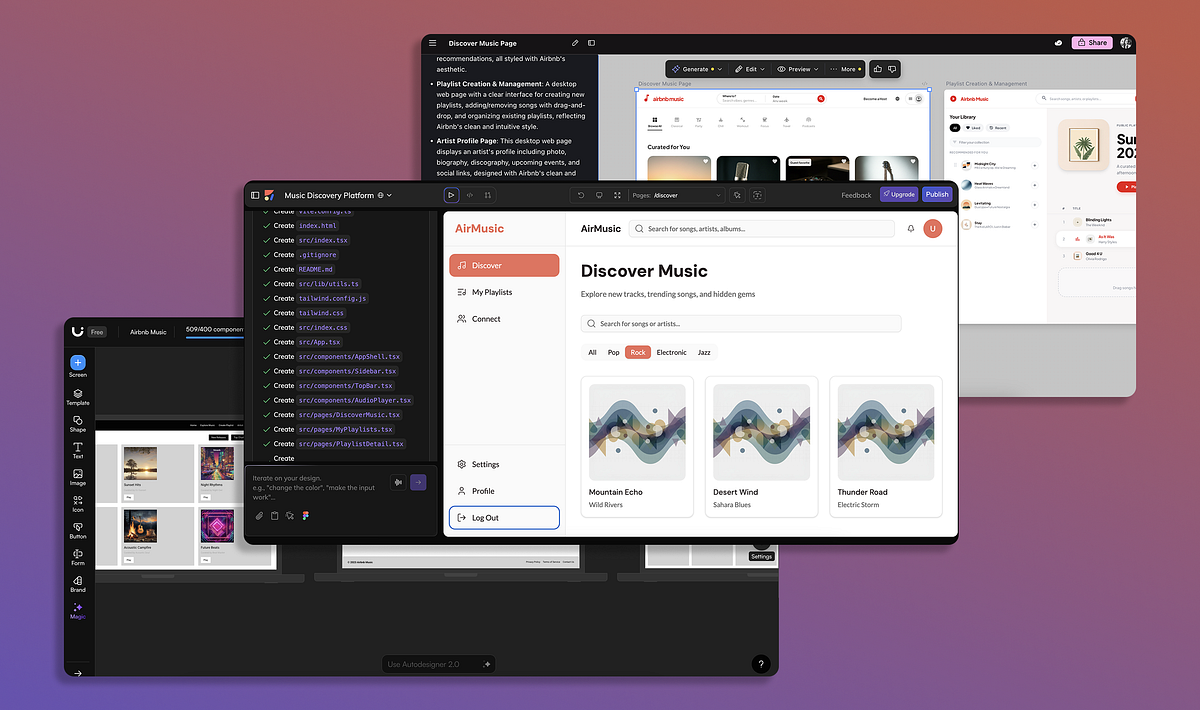
"But still...most of it feels short-lived and unusable. The generated screens look convincing, but they're treated as placeholders instead of starting points in the ideation process. For instance, when a generated screen needs to reflect a brand's styling, handle real data, or align with existing patterns, the work has to be rebuilt (and the generated UI is tossed). This is simply a mismatch between how UI is generated in AI tools and how products are actually built."
"AI-generated screens typically use visual styles that are neutral, like system-default colors and typography. Though the UI feels "close enough," it's not truly accurate to your product's brand (or any other brand you want to test). And once real branding is introduced, the UI designs break down from the gaps created from the neutral styling used during generation. This ultimately causes rework to better incorporate the product's branding (either restyling elements or starting over completely)."
"So instead of avoiding constraints such as branding and data, they need to be integrated into the generation process. This way, the UI becomes more valuable and can be used to continue to iterate past a demo or proof of concept (POC) phase. Let's look at 3 constraints (brand styles, data, and pattern reuse) that separate generated UI that gets discarded versus UI that is used end-to-end in the product development cycle."
AI-generated UI tools produce high-quality, fast screens that often become unusable because they use neutral styling and placeholder data, requiring rebuilds. Integrating brand styling into initial generation prevents visual breakdowns when real branding is applied and reduces rework. Supplying realistic data or connecting generation to actual data schemas prevents placeholder content from failing in development. Enforcing pattern reuse by referencing component libraries and design system variants ensures generated screens conform to engineering constraints and accelerate handoff. Treating brand, data, and reuse as generation constraints creates outputs that are closer to production-ready, enabling iteration past demos or proofs of concept.
Read at Medium
Unable to calculate read time
Collection
[
|
...
]