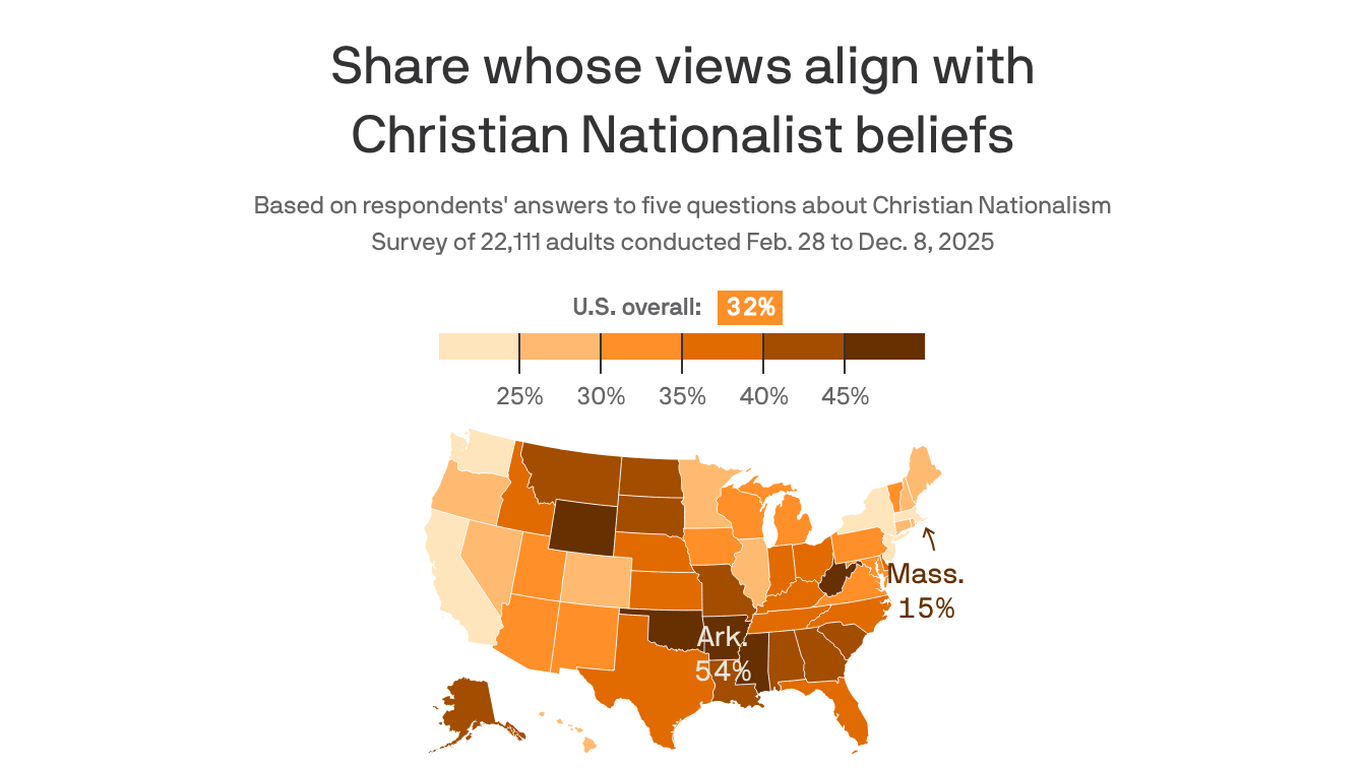
"The divide reflects a broader clash over whether America's future is pluralistic or rooted in a singular religious-national identity. By the numbers: About one-third of Americans qualify as Christian nationalism "adherents" or "sympathizers," a new survey released Tuesday by the nonpartisan Public Religion Research Institute finds. 56% of all Republicans are Christian nationalism "adherents" or "sympathizers," the survey said. Meanwhile, only 25% of independents and just 17% of Democrats are "adherents" or "sympathizers," according to the survey."
"State of play: Many adherents say the U.S. was founded as the "Promised Land" for white European Christians, and falsely believe the founding fathers sought to create a Christian nation, PRRI president Robert P. Jones tells Axios. Critics say Christian nationalism reinforces rigid, male-dominated leadership models in church, home and government, and merges religious identity with white ethnic nationalism. It also elevates Christianity - often a specific conservative Protestant expression - above other faiths."
"PRRI first developed its five-question Christian nationalism scale in 2022, measuring agreement with statements such as declaring the U.S. a Christian nation and basing laws on Christian values. The overall share of Americans qualifying as "Adherents" or "Sympathizers" has remained largely steady over the past three years. Zoom in: The new survey also shows that Christian nationalism strongly correlates with those who have a favorable opinion of President Trump and those who live in states with GOP-controlled state legislatures."
About one-third of Americans qualify as Christian nationalism adherents or sympathizers, with 56% of Republicans meeting that measure compared with 25% of independents and 17% of Democrats. Many adherents assert the U.S. was founded as a "Promised Land" for white European Christians and believe the founders intended a Christian nation. Critics say Christian nationalism fuses religious identity with white ethnic nationalism, elevates conservative Protestant expressions of Christianity above other faiths, and endorses rigid, male-dominated leadership models. PRRI developed a five-question scale in 2022, and the overall share has remained largely steady over three years.
Read at Axios
Unable to calculate read time
Collection
[
|
...
]