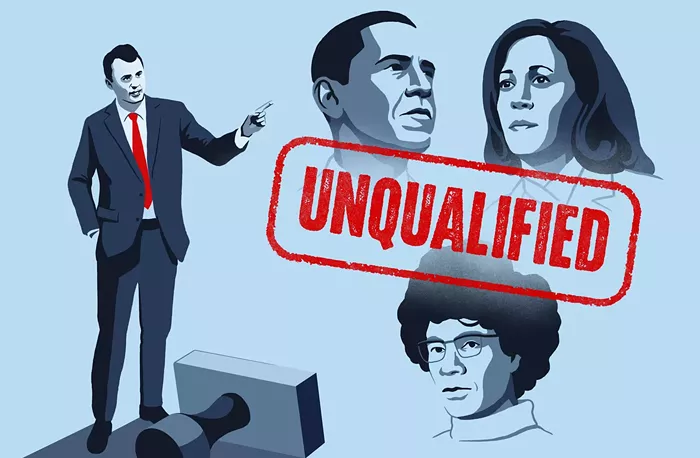
"Could she be the First Black woman to be president? Kamala, or rather her platform, was hardly inventive. When engaged on its fundamentals, it was largely conservative. Not conservative like Charlie Kirk... conservative meaning, it preserved many pieces of America as is-just as a conservationist preserves the trees of a forest. It was a platform that largely fit hand-in-glove with Bidenomics: protect corporate global interests, overfund all military and law enforcement, and yes-promote electric cars, along with a dash of maternal health reform, abortion protections, and a short-lived national rent cap promise."
"So while racists and right-wing extremists predictably (and laughably) labeled her a "communist" and "Comrade Kamala," it's noteworthy that the former San Francisco district attorney-while certainly more left than any Dixiecrat-was hardly the face of The Revolution™. I mean, she campaigned with Liz Cheney, guys. Like, Dick's daughter. Dick's daughter, guys."
Kamala Harris nearly became the country's first Black woman president but lost to Donald Trump in his third presidential run. Her platform aligned closely with Bidenomics and was largely conservative in practice, preserving corporate interests, overfunding military and law enforcement, and promoting electric vehicles alongside modest maternal health reforms, abortion protections, and a temporary rent cap pledge. Critics labeled her a communist, despite her background as a former San Francisco district attorney who campaigned with centrist Republicans such as Liz Cheney. The campaign offered symbolic representation without promising radical systemic change.
Read at Portland Mercury
Unable to calculate read time
Collection
[
|
...
]