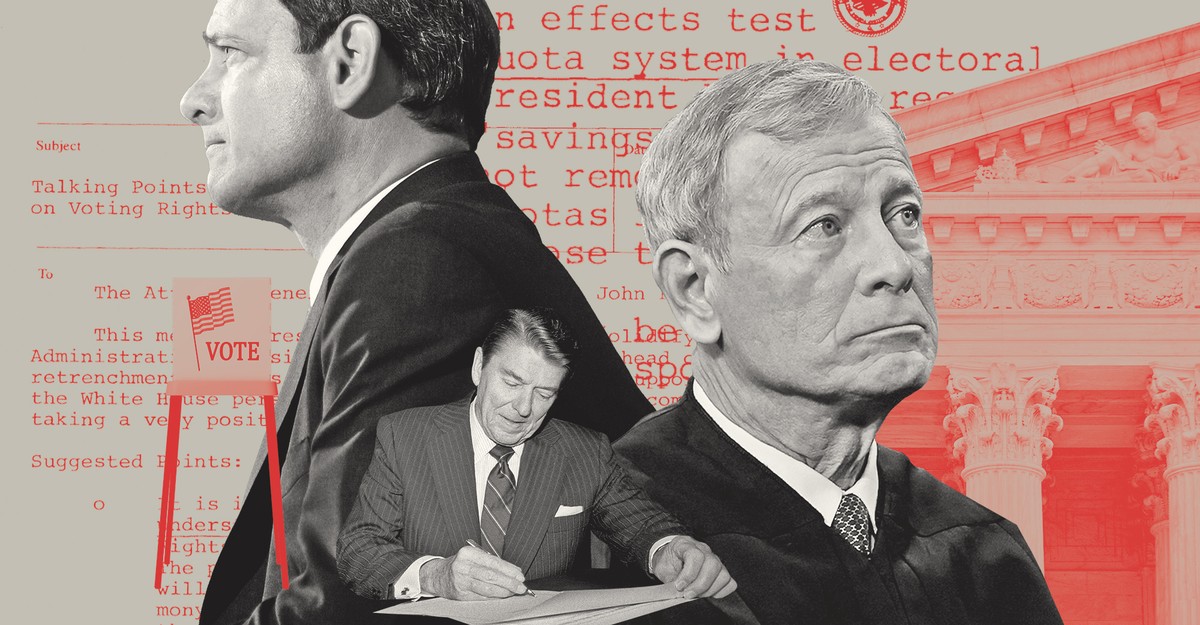
"Last month, at the oral argument in Louisiana v. Callais, a majority of theconservative justices seemed to signal their willingness to forbid any use of race data in redistricting. That could lead to the end of the VRA's Section 2 protections for minority voters, and allow states across the South to redraw congressional districts currently represented by Black Democrats into whiter, more rural, and more conservative seats, potentially before the 2026 midterms."
"A central question of the case, hotly debated during oral arguments, is whether Section 2 should prohibit election laws and procedures that have a racially discriminatory effect, or just those passed with clear racially discriminatory intent. Roberts almost certainly had flashbacks. This is the same question that was at the center of the 1982 reauthorization fight. Back then, the future chief justice's job was to design the Department of Justice's VRA strategy."
In 1982, the Reagan Justice Department sought to preserve the Voting Rights Act in name while making it unenforceable; John Roberts designed that strategy. During Louisiana v. Callais oral argument, conservative justices signaled willingness to forbid use of race data in redistricting, potentially ending Section 2 protections and allowing Southern states to redraw Black-held districts into whiter, rural, conservative seats before 2026. The central legal question is whether Section 2 prohibits practices with racially discriminatory effects or only those enacted with discriminatory intent. A 1980 Supreme Court decision, City of Mobile v. Bolden, had required proof of discriminatory intent and stalled Section 2 litigation.
Read at The Atlantic
Unable to calculate read time
Collection
[
|
...
]