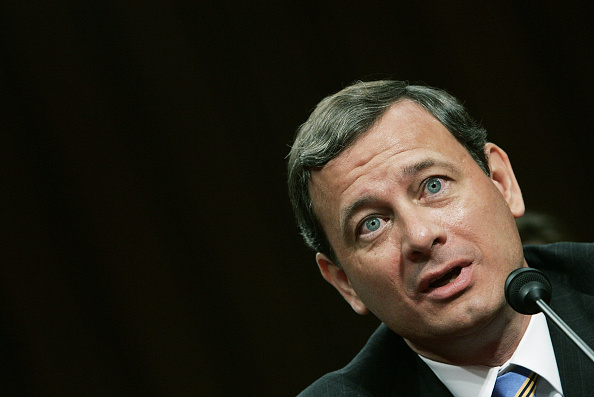
""I think at a very basic level, people think we're making policy decisions, [that] we're saying we think this is what things should be as opposed to this is what the law provides. I think they view us as truly political actors, which I don't think is an accurate understanding of what we do.""
"Over the last several years, Roberts has fed the media manicured sound bites as a reluctant scold, chastising the public for not understanding the Supreme Court's very important work and getting pre-occupied with unimportant trifles like " justices taking hundreds of thousands of dollars under the table." It's just so TRAGIC that people care more about the Supreme Court erasing decades worth of civil rights as opposed to the real threat: hurting the Court's public approval rating."
"Roberts defended the Supreme Court from what he characterized as the public's unfortunate misconceptions: "I think at a very basic level, people think we're making policy decisions..." Yes, how could anyone mistake the Supreme Court's conservative majority for "political actors" mere days after throwing aside decades of well-settled law to rewrite the nation's election laws."
"A move that the Supreme Court took only after Democrats in California and Virginia responded to Republican gerrymandering efforts, creating a new political crisis for the Republican Party that didn't exist over the prior 61 years. After all that time, the majority decided it was so obviously unconstitutional that they had to rush out a decision in the middle of an active election and waive its longstanding rules to make sure other states get their new maps in under the wire."
People are described as believing the Supreme Court makes policy decisions and acts politically, rather than applying the law. The Supreme Court is characterized as providing what the law requires, not deciding what things should be. The public is criticized for focusing on allegations about justices taking large sums of money improperly. The Supreme Court’s actions are framed as erasing civil rights and rewriting election laws, including decisions made during active elections and waiving longstanding rules to meet deadlines for new election maps. The narrative contrasts public concern about civil rights and election changes with concern about the Court’s public approval rating.
Read at Above the Law
Unable to calculate read time
Collection
[
|
...
]