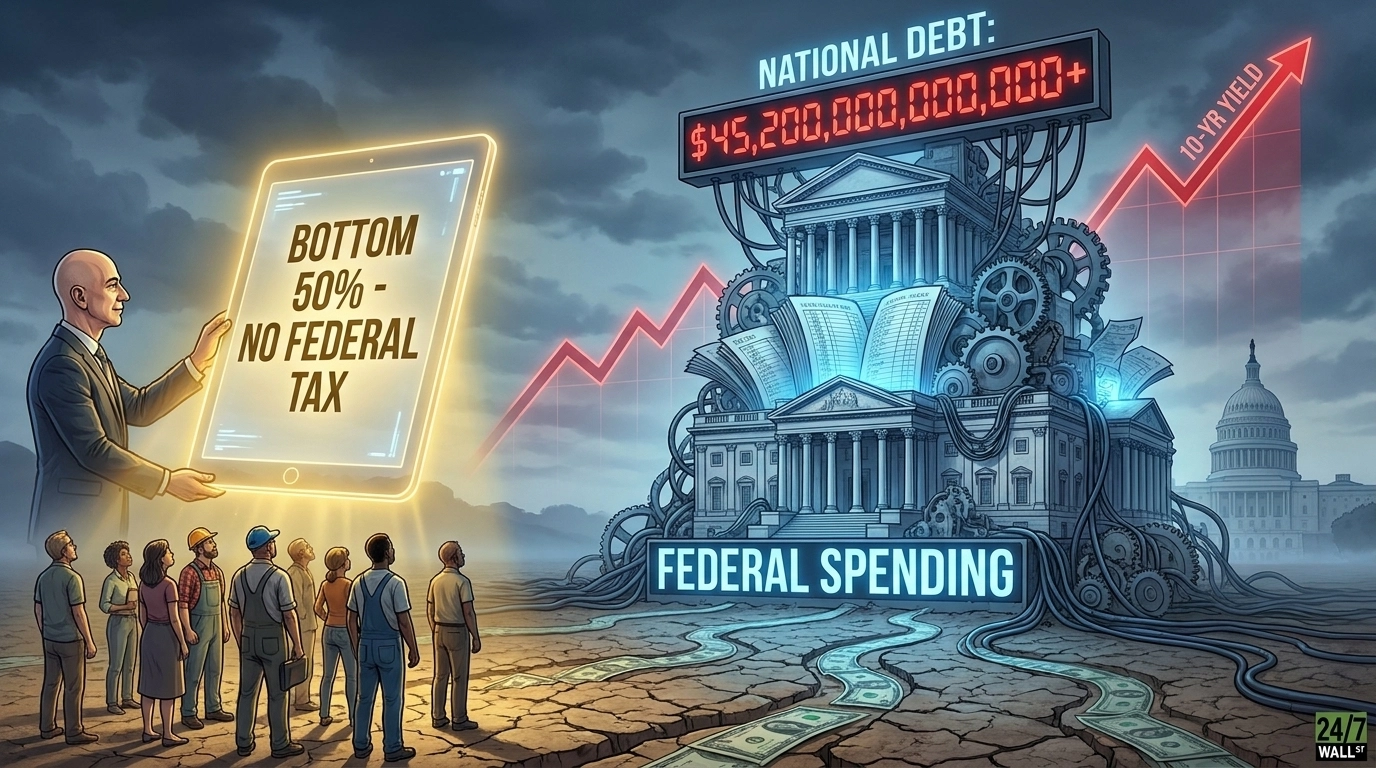
Jeff Bezos proposed that the bottom 50% of Americans should pay no federal taxes. The argument centers on how federal payments reduce working-class cash flow, using an example of someone earning $70,000 who sends $10,000 to $12,000 to Washington. The proposal is framed against strained household finances, including tax bracket thresholds and standard deductions that place many middle-income earners near higher marginal rates. Per-capita disposable personal income is cited as $68,617 in Q1 2026, while the personal savings rate fell to 4.0% in Q1 2026 from 6.2% in early 2024. The claim that the bottom half contributes about 3% of federal revenue is presented as the main support for the idea.
"Bezos believes the bottom 50% of Americans should pay no federal taxes. According to the discussion, the bottom half of earners currently contribute only 3% of the federal budget, which lends credence to the argument that they shouldn't pay federal taxes at all."
"Pompliano framed Bezos's argument around working-class cash flow. "If you make $70,000, if you're sending $10,000 or $12,000 to Washington, one, that's an incredible amount of of your, of the money that you need to live," Pompliano said during the segment."
"Under 2026 IRS tax brackets tied to the "One, Big, Beautiful Bill," single filers move into the 22% marginal bracket above $50,400 of income, while the standard deduction sits at $16,100. Meanwhile, U.S. per-capita disposable personal income reached $68,617 in the first quarter of 2026, placing a hypothetical $70,000 worker almost directly in the middle of the income range Bezos appears focused on."
"The key figure supporting Bezos's proposal is that the bottom half of earners contribute only about 3% of total federal revenue. Pompliano did not break down the precise fiscal impact of eliminating those taxes, but the number served as the foundation for why the proposal could sound plausible at first glance."
Read at 24/7 Wall St.
Unable to calculate read time
Collection
[
|
...
]