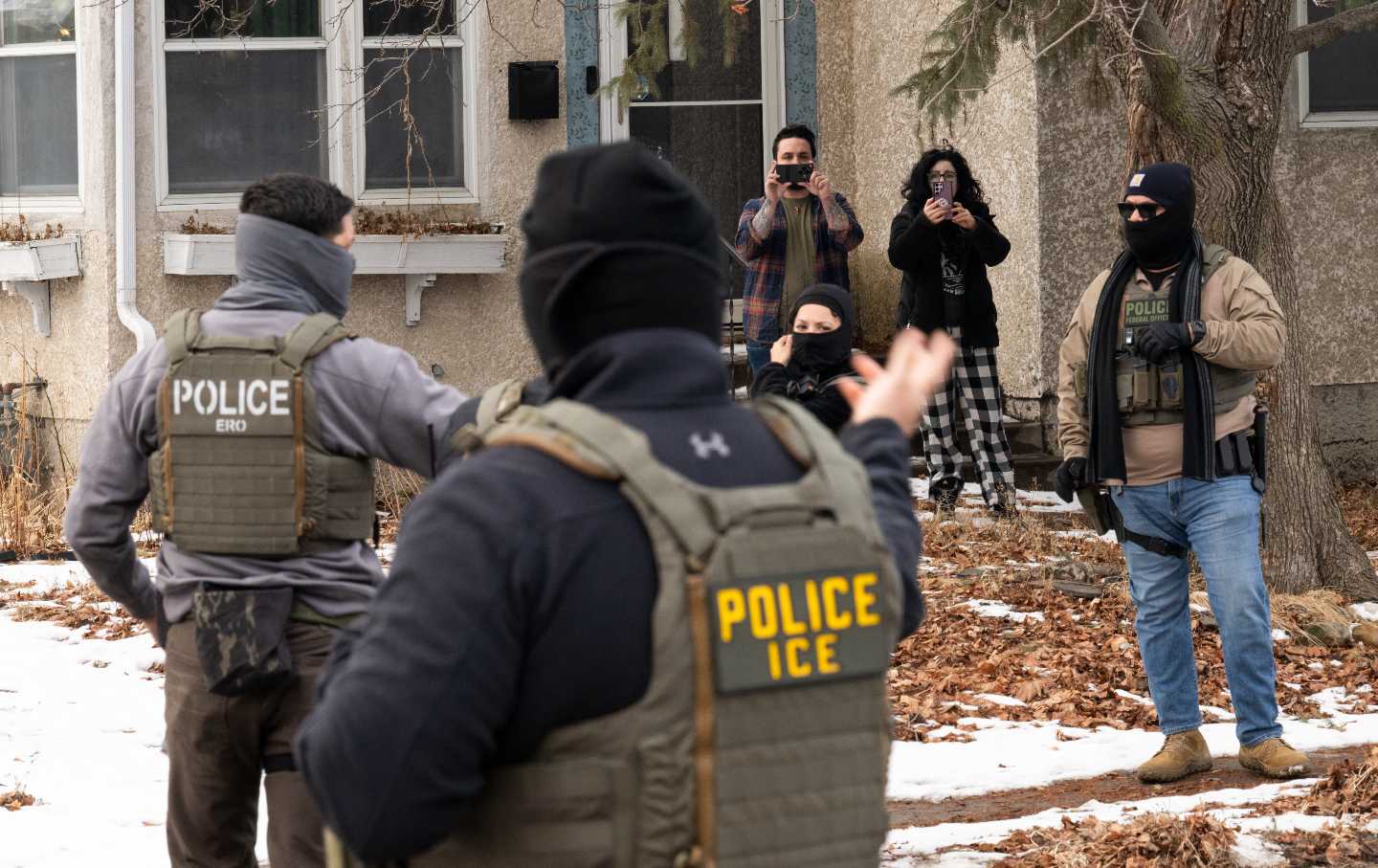
"Over 2,600 students and legal academics have signed a letter calling on Congress to close a loophole to allow individuals to sue federal officers for violating the Constitution. At a moment when lawless conduct by federal immigration agencies is facing increased public scrutiny following the killings of Renee Good and Alex Pretti, a coalition of law students is demanding that Immigration and Customs Enforcement (ICE) and Customs and Border Protection (CBP) officials be held to account for their violence across our nation."
"What started as a late-night idea, inspired by an opinion essay by Berkeley Law Dean Erwin Chemerinsky and professor Burt Neuborne, has become a nationwide movement. I worked with a group of Berkeley Law students, including my peers Zadie Adams, Isaiah Paik, Shree Mehrotra, and Kaylana Mueller-Hsia, and professors to write and circulate a letter to Congress calling for a federal equivalent of Section 1983 that would close a long-standing loophole and allow individuals to sue federal officers for constitutional violations."
"Currently, Section 1983 allows individuals to sue state or local officers for constitutional violations, but not federal officials. A federal version of Section 1983 would allow people to hold federal officers accountable when their rights are violated. Our proposed bill preserves the original meaning of Section 1983 by eliminating qualified immunity, a doctrine that lets many officials escape accountability for constitutional violations."
Over 2,600 students and legal academics have signed a call to Congress to create a federal equivalent of Section 1983 enabling individuals to sue federal officers for constitutional violations. Law student organizers cite increased scrutiny of federal immigration agencies after the killings of Renee Good and Alex Pretti and seek accountability for ICE and CBP violence. The proposed bill would extend the remedial structure of Section 1983 to federal officers and eliminate the qualified immunity defense that often bars recovery. Section 1983 originally contained no qualified immunity when enacted in 1871, and the Supreme Court later developed the doctrine; students across multiple law schools mobilized rapidly.
Read at The Nation
Unable to calculate read time
Collection
[
|
...
]