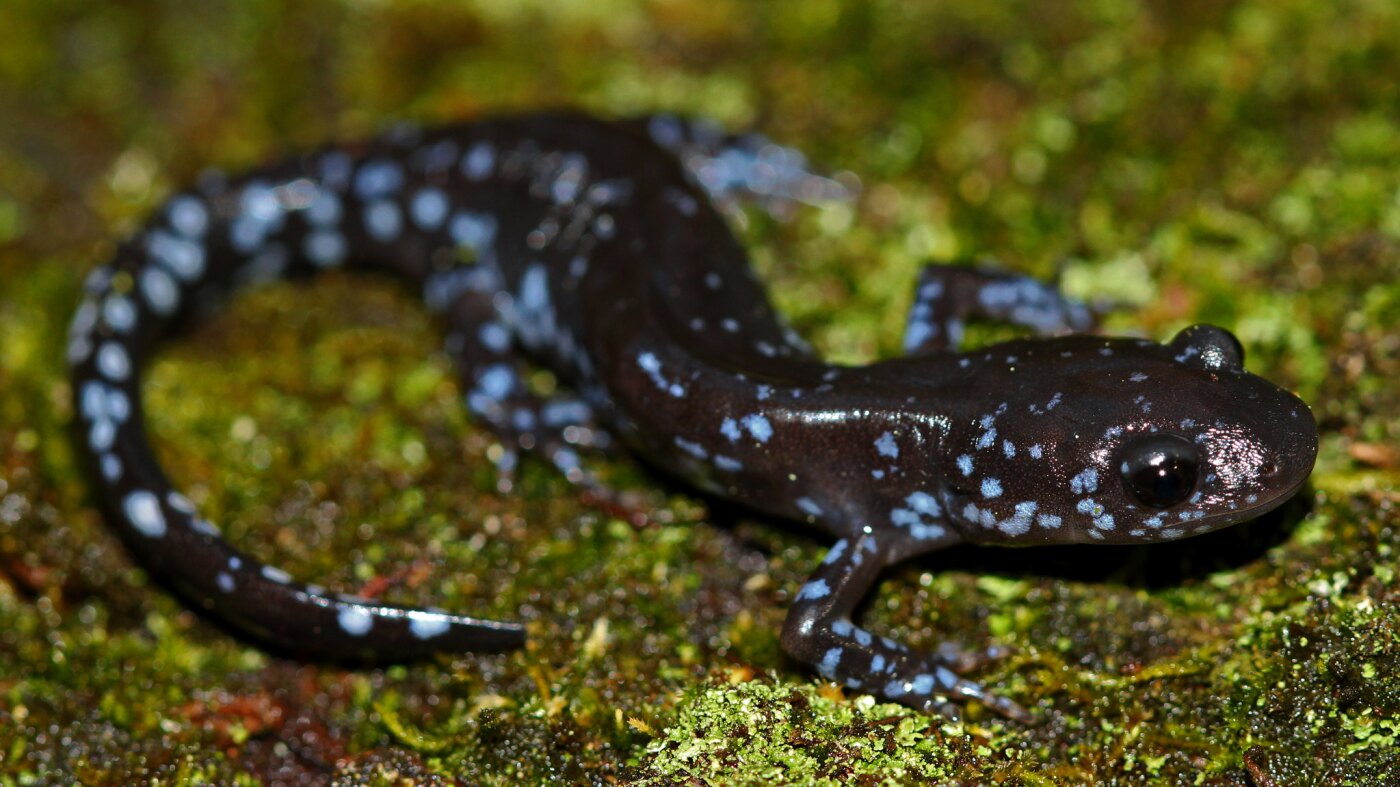
"In ancient times, people thought moist-skinned salamanders could survive in fire. That's not true, of course, but some salamanders have a surprising ability to deal with another temperature extreme: freezing cold. In fact, blue-spotted salamanders can remain active even when chilled below the normal freezing point of body fluids a state that scientists call "supercooled." That surprised researchers who recently saw these amphibians out and about at Bat Lake in Canada's Algonquin Provincial Park in late winter."
"These salamanders live up to their name, with black bodies sporting shimmery blue spots. Besides Canada, they're found in the northern part of the United States, across the Great Lakes region and New England, up into Canada. They spend cold winters underground, but emerge from their burrows in the forests in early spring to migrate to nearby pools of water so that they can start breeding."
Blue-spotted salamanders can remain active when chilled below the normal freezing point of body fluids, a state called supercooled. Individuals were observed active on land at Bat Lake in Algonquin Provincial Park in late winter despite ice and a frozen lake. These salamanders have black bodies with shimmery blue spots and range across the northern United States, the Great Lakes region, New England, and into Canada. They normally spend winters underground and emerge in early spring to migrate to nearby pools for breeding, but sightings on snow and in frigid conditions indicate notable cold tolerance. Thermal imaging detected body temperatures as low as 25 degrees Fahrenheit in some animals.
Read at www.npr.org
Unable to calculate read time
Collection
[
|
...
]